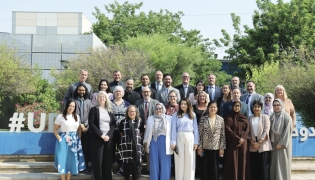
Doha, Qatar: The Arab Network of National Human Rights Institutions, which is based in Doha, yesterday concluded its international conference titled, “Protecting Children in the Digital Space: Challenges, Legislation, and Preventive Measures.” The conference was held alongside the Network’s 25th General Assembly, which convened in Bahrain over two days.
In this context, Secretary-General of Arab Network of National Human Rights Institutions H E Sultan bin Hassan Al-Jamali, presented the conference’s recommendations. These called for the enactment of legislative systems that criminalise and penalise behaviours that infringe upon children’s rights in the digital space, restrict harmful content across information networks, and include mechanisms to protect children from online exploitation and violations in line with international standards, while taking into account cross-border cybercrimes.
The recommendations also urged the establishment of legal and procedural frameworks to protect children’s personal data across all digital platforms, obliging digital service providers to adhere to responsible corporate conduct and to take strict measures to prevent exploitation and violations of children’s privacy.
They further called on states to adopt a unified standard to combat cybercrime in order to prevent criminals from exploiting countries with less stringent laws.
The recommendations emphasised the importance of adopting national strategies and action plans that ensure the prevention of digital risks against children and provide protection mechanisms for children and adolescents. They also stressed integrating digital safety concepts into educational curricula, teaching children safe ways to engage with the digital space, involving families in monitoring children’s digital behaviour, and adopting a participatory approach to formulating digital policies related to children, ensuring the involvement of all relevant stakeholders, including children themselves.
The recommendations underscored the need to establish specialized structures concerned with children’s rights within the internal organization of national human rights institutions, alongside strengthening the role of the family, schools, and civil society in protecting children from harmful content.
They also called for the implementation and organization of continuous awareness programs targeting children, parents, and teachers to clarify digital risks and ways to prevent them, as well as the provision of specialised training programmes for law enforcement bodies concerned with childhood issues (judges and public prosecutors), in addition to teachers and social workers, to enable them to address digital crimes efficiently and swiftly and to protect children effectively.
The recommendations highlighted the importance of raising awareness and building capacities in digital rights and dimensions among staff of national human rights institutions, and establishing a specialized public prosecution office to handle digital crimes against children. Its mandate would include initiating criminal proceedings in the name of society before competent courts, with the aim of enhancing the role of judicial officers authorized to monitor and investigate crimes committed against children.
They further pointed to the necessity of establishing unified, child-friendly national mechanisms for the immediate reporting of crimes related to children arising from the use of the digital space, as well as for collecting relevant data, statistics, and information.