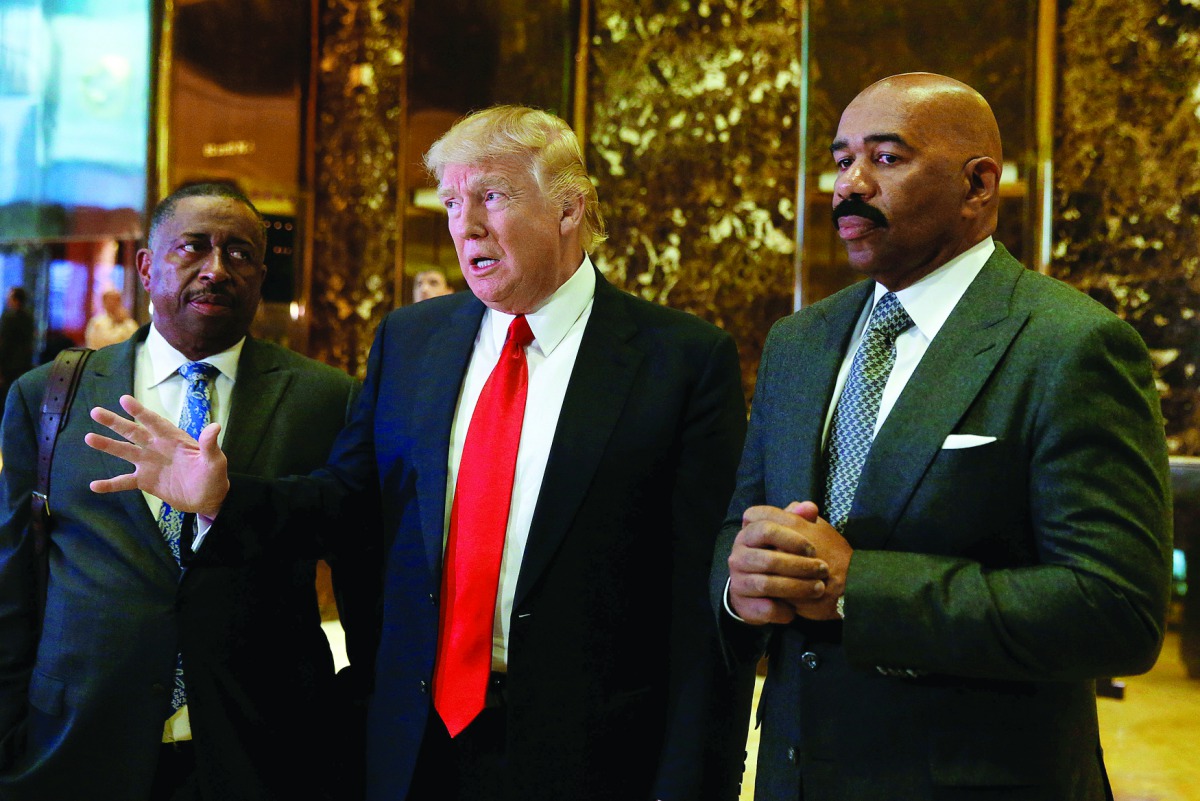
US President-elect Donald Trump speaks to members of media with television personality Steve Harvey (right) and businessman Greg Calhoun after their meeting at Trump Tower in New York, yesterday.
Washington: President-elect Donald Trump’s national security adviser and Russia’s ambassador to the US have been in frequent contact in recent weeks, including on the day the Obama administration hit Moscow with sanctions in retaliation for election-related hacking, a senior U.S. official says.
After initially denying that Michael Flynn and Ambassador Sergey Kislyak spoke on December 29, a Trump official said yesterday that the transition team was aware of one call on the day President Barack Obama imposed sanctions.
It’s not unusual for incoming administrations to have discussions with foreign governments before taking office. But repeated contacts just as Obama imposed sanctions would raise questions about whether Trump’s team discussed — or even helped shape — Russia’s response.
Russian President Vladimir Putin unexpectedly did not retaliate against the US for the move, a decision Trump quickly praised.
More broadly, Flynn’s contact with Russian ambassador suggests the incoming administration has already begun to lay the groundwork for its promised closer relationship with Moscow. That effort appears to be moving ahead, even as many in Washington, including Republicans, have expressed outrage over intelligence officials’ assessment that Putin launched a hacking operation aimed at meddling in the U.S. election to benefit Trump.
In an interview published by The Wall Street Journal, Trump said he might do away with Obama’s sanctions if Russia works with the US on battling terrorists and achieving other goals.
“If Russia is really helping us, why would anybody have sanctions?” he asked.
During a news conference Wednesday, Trump highlighted his warmer rapport with the Russian leader.
“If Putin likes Donald Trump, I consider that an asset, not a liability, because we have a horrible relationship with Russia,” he said.
The sanctions targeted the GRU and FSB, leading Russian intelligence agencies that the US said were involved in hacking of the Democratic National Committee and other groups. The US also kicked out 35 Russian diplomats who it said were actually intelligence operatives.
Trump accepted a call from Taiwan’s president, ignoring the longstanding “One China” policy that does not recognise the island’s sovereignty. Asked about that yesterday by the Journal, he responded, “Everything is under negotiation.”
He also publicly urged the US to veto a United Nations Security Council resolution condemning Israeli settlements, then slammed Obama administration for abstaining and allowing the measure to pass.
Questions about Trump’s friendly posture toward Russia have deepened since the election, as he has dismissed US intelligence agencies’ assertions about Russia’s role in hacking of Democratic groups. In briefing Trump on their findings, intelligence officials also presented the president-elect with unsubstantiated claims that Russia had amassed compromising personal and financial allegations about him, according to a separate US official who spoke on condition of anonymity because the official was not allowed to discuss the matter.
The Senate Intelligence Committee announced yesterday it would investigate possible contacts between Russia and people associated with US political campaigns as part of a broader investigation into Moscow’s meddling in the 2016 presidential election.
Trump acknowledged for the first time this week that he accepts that Russia was behind the hacking. But he questioned whether officials were leaking information about their meetings with him, warning that would be a “tremendous blot” on their record.
Flynn’s own ties with Russia have worried some Republicans who are more sceptical of the Kremlin than Trump appears to be. After leaving his position as director of the Defence Intelligence Agency in 2014, Flynn made appearances on RT, a state-run Russian television network. In 2015, he was paid to attend an RT gala in Moscow, where he sat next to Putin.
As national security adviser, Flynn will work in the West Wing close to the Oval Office and will have frequent access to Trump. Unlike Trump’s nominees to lead the Pentagon, State Department and other national security agencies, Flynn’s post does not require Senate confirmation.
Flynn’s contacts with the Russian ambassador were first reported by Washington Post columnist David Ignatius.