Professor Jeffrey Heath (right) giving a presentation at the conference yesterday.
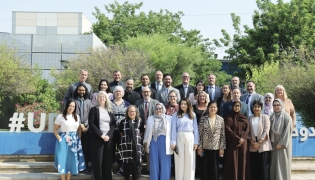
Doha: Qatar University’s Department of English Literature & Linguistics in the College of Arts & Sciences (CAS) yesterday opened its fourth Linguistics in the Gulf conference.
The purpose of the two-day conference is to gather researchers from the region and abroad for an exchange of ideas and reflections on current and future developments in the study of language, organisers said.
“During these two days, delegates will address new challenges facing linguistics researchers and share experiences with colleagues from institutions in the region and beyond to advance the ongoing dialogue on this important area of study,” CAS Dean Dr Eiman Mustafawi, said.
“Findings and recommendations coming out of these discussions will serve to update upcoming researchers and students in the region on developments in Arabic linguistics,” Mustafawi said.
The first day’s keynote speaker Professor Jeffrey Heath, University of Michigan Professor of Historical Linguistics, Morphology, Arabic and Linguistic Anthropology, presented his study on “Early Moroccan Arabic as a pidgin/creole language”.
“This is an excellent platform for linguists in the region and abroad to engage in the exchange of ideas about the study of language in the region. The Gulf in general and Qatar in particular represent a living “linguistic laboratory” for linguists of all specialisations,” Department Chair Dr Rizwan Ahmad said.
The conference included presentations by linguistics experts and researchers from University of Bucharest, University of Business and Technology, University of York, Birkbeck, University of London, University of Iowa, Mansoura University, American University of Sharjah, University of Newcastle, University of Sharjah, New York University, New York University – Abu Dhabi, University of Texas at Austin, UAE University, King Abdulaziz University, Sultan Qaboos University, Hyderabad University, and University of Montreal.
The papers presented deal with both structural and social aspects of language in the Gulf including Standard Arabic, Gulf dialects, and Pidgin Arabic, and discuss empirical linguistic data that inform and advance theoretical understanding of language and its social, cognitive, and neurological representations.
Department member Mariam Gammaz presented “Cultural and linguistic challenges in translation” in the session titled “Translation and Beyond” as part of her master’s programme at the University of Portsmouth, UK.
The second day’s keynote speaker, Georgetown University Associate Professor of Arabic linguistics, Dr Reem Bassiouney, will give a presentation on “Arabic Indexes amidst a Nation and a Nation-State: Ideologies, Attitudes and Linguistic Realities”.
The Peninsula