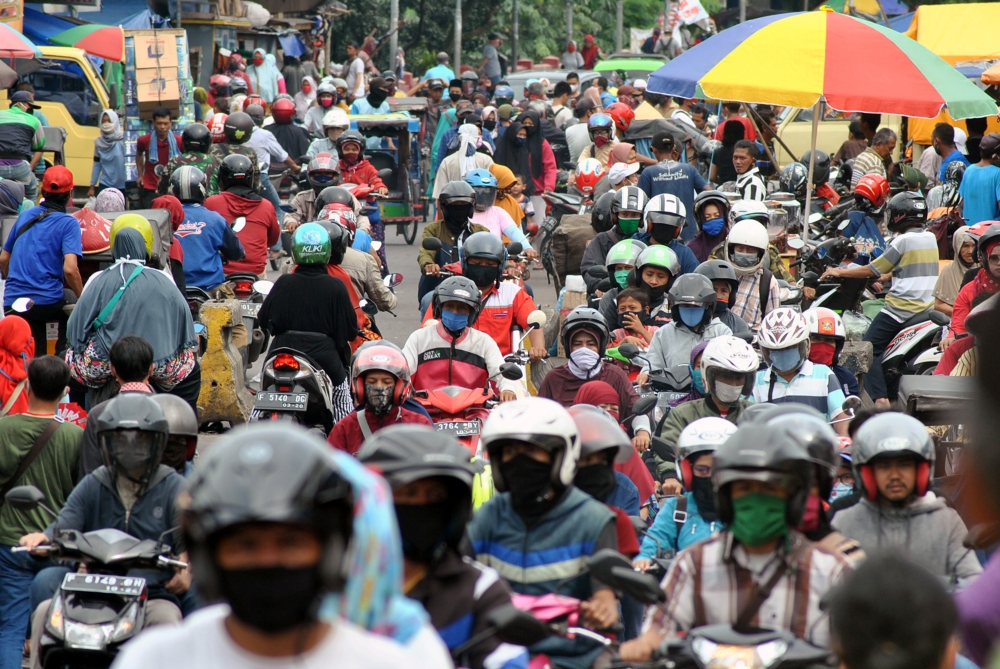
People are seen at a traditional market amid the coronavirus disease (COVID-19) outbreak in Bogor, near Jakarta, Indonesia May 18, 2020, in this photo taken by Antara Foto. Antara Foto/Arif Firmansyah/via REUTERS
Indonesian President Joko Widodo ruled out an immediate easing of social distancing rules and ordered officials to strictly enforce a ban on travel during the busy holiday season to prevent a spike in new coronavirus cases.
With new infections soaring 73% so far in May, Jokowi, as the president is known, asked officials at a cabinet meeting to increase the surveillance of industrial clusters and focus on enforcing mobility restrictions at the village level. While the government is preparing various scenarios for reopening the economy, no deadline has been set yet, he said.
The spike in infections in recent weeks may delay plans to reopen Southeast Asia’s largest economy as early as next month as an overwhelmed healthcare system fails to ramp up testing of those with even explicit Covid-19 symptoms. With reports of a large number of people traveling to their hometowns to celebrate the Muslim festival of Eid al-Fitr later this month in defiance of the ban on such travel, known as mudik, fears have increased of a fresh wave of infections.
"In the next two weeks, the government will focus on enforcing the ban on mudik and controlling the flow of people returning to cities,” Jokowi said. He asked the military and police to prevent holiday travel but ensure the smooth transport of essential supplies and to support healthcare logistics, and also allow the movement of returning migrant workers.
The number of infections in Indonesia rose to 17,514 on Sunday with the death toll climbing to 1,148, one of the highest among Asian nations. Almost 36,000 people were suspected of contracting the virus and exhibiting symptoms but still awaiting clinical confirmation, official data show. With more than 270,000 people under observation nationwide, Jokowi asked officials to start using the more than 10,000 community health clinics as nodal points for sample testing, tracing and isolation.
The president also ordered officials to accelerate the distribution of cash, food and other social assistance. Jokowi’s administration has announced economic stimulus totaling about $28 billion to cushion the impact of the pandemic that’s left millions of people without jobs and any means of livelihood.
An estimated six million people from industries as diverse as tourism to textiles and retail have lost their jobs since the outbreak of the pandemic, according to Rosan Roeslani, chairman of the Indonesian Chamber of Commerce and Industry.
"The condition of the hotel industry is very miserable,” Roeslani said in a phone interview. "Previously I thought the pharma sector was doing fine, but their association has reported that their condition is also bad.
They are hit by a shortage of raw materials, high prices, a weak rupiah and inability to raise drug prices.”