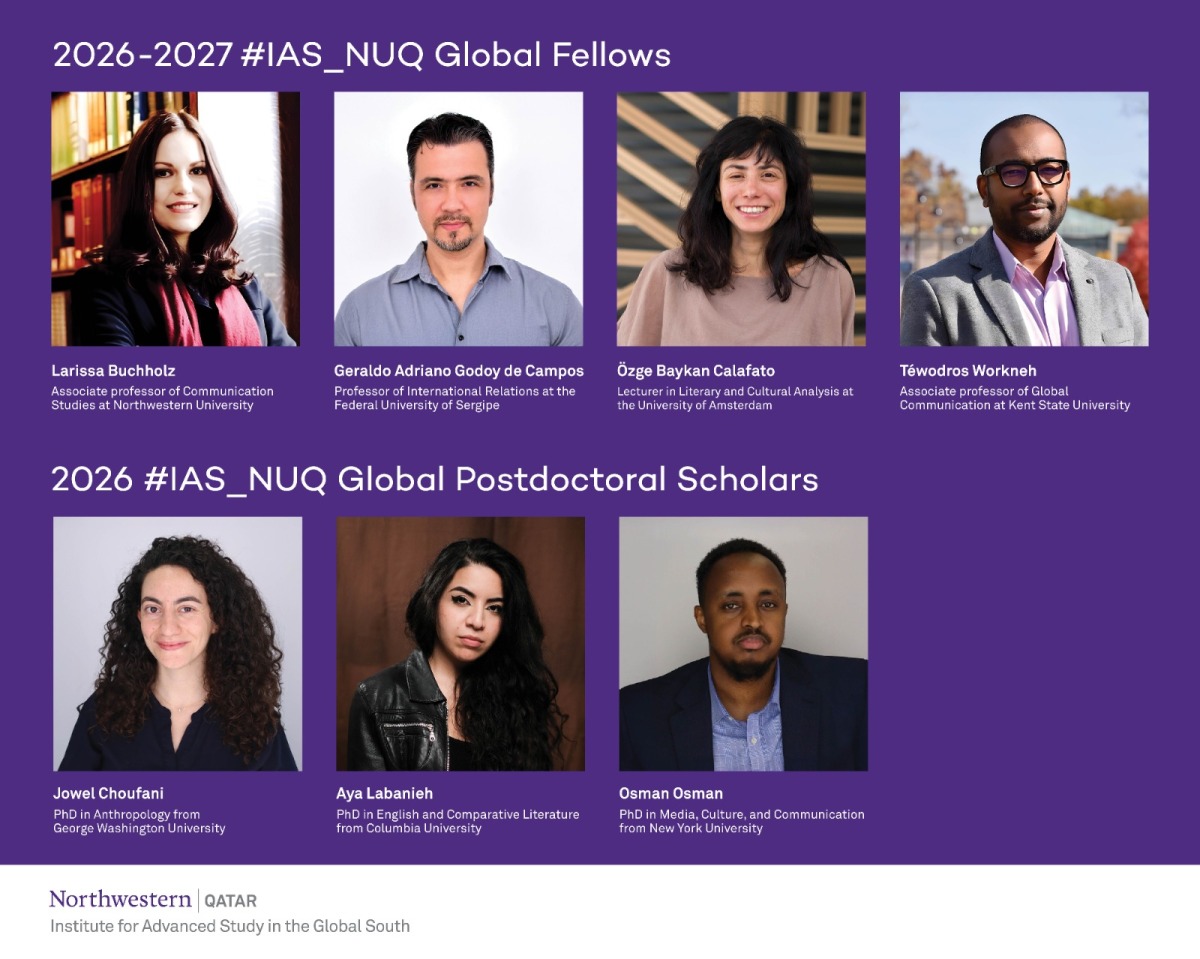
Doha, Qatar: Seven scholars from leading universities around the world will join the Institute for Advanced Study in the Global South at Northwestern University in Qatar (#IAS_NUQ) during the 2026–27 academic year, strengthening the University’s role as a global hub for research, dialogue, and knowledge production on the Global South. Jowel Choufani, Aya Labanieh, and Osman Osman will join as Global Postdoctoral Scholars, while Larissa Buchholz, Geraldo Campos, Özge Calafato, and Teddy Workneh will be in residence as Global Fellows.
The #IAS_NUQ Global Fellowship and #IAS_NUQ Global Postdoctoral Scholars programs are central to the Institute’s efforts to build a sustained, interdisciplinary community of researchers working on the Global South.
The Global Postdoctoral Scholars program supports early-career researchers through long-term appointments, allowing them to advance historically grounded, theoretically informed research and mediamaking while contributing to program development, teaching, public scholarship, and publications with #IAS_NUQ_Press.
By contrast, the Global Fellowship program brings established and emerging scholars for shorter residencies up to one academic term, providing dedicated time and space to develop ongoing projects while engaging with the wider intellectual community at Northwestern Qatar. Both are residential programs that place sustained collaboration at the center of the scholars’ experience.
“Universities have a responsibility not only to generate knowledge, but also to expand the types of knowledge that matter,” said Marwan M. Kraidy, dean and CEO of Northwestern University in Qatar. “Many of today’s most consequential intellectual questions are being asked from, and answered within, the Global South. This cohort reflects our commitment to bringing together scholars whose work challenges conventional thinking, advances interdisciplinary research, and broadens global understanding.”
Choufani is an anthropologist whose work examines state abandonment, community-based infrastructures of solidarity, and the moral and political economies that shape them. She received her PhD in anthropology from George Washington University in 2026.
Her dissertation, “Negotiating Obligation Amidst Organized Abandonment: Relatedness and Belonging in Contemporary Lebanon,” is an ethnographic study of how people connected to Lebanon mobilize and enact forms of obligation, including wajeb, an Arabic term spanning political, relational, and religious registers. As an #IAS_NUQ Global Postdoctoral Scholar, Choufani will develop the dissertation into a monograph by expanding its historical scope to trace ruptures and continuities in how wajeb has been constituted and circulated across key moments in Lebanon’s history.
She will also begin a new project on how traditional food preserves, or mouneh, are transformed into politically charged commodities through markets that combine humanitarian relief, cultural heritage, and corporate infrastructure.
Labanieh received her PhD in English and comparative literature from Columbia University in 2025. Her research examines the intersections of conspiracy, memory, and power across Anglophone and Arabophone literature and media, from dystopian fiction and internet subcultures to the memoirs of agents and spies. Labanieh’s project uses conspiracy as both an object of study and an analytical lens for examining the relationship between colonial history and cultural memory in the 20th-century Middle East.
While in residence, she will develop her dissertation into a monograph and add a final chapter on how the conspiracy trope evolved during the transition from colonial subjecthood to state citizenship and the rise of autocratic Arab security regimes. Focusing on Baathist Syria and Iraq from the 1970s through the 1990s, she will analyze representations of regime informants and how dissidents deployed the rhetoric of conspiracy under conditions of surveillance and exile.
Osman earned his PhD in media, culture, and communication from New York University and a master’s degree from The Media School at Indiana University Bloomington. His research lies at the intersection of critical security studies and the sociology of news production, examining how journalistic fields in postcolonial contexts construct narratives of conflict and politics and how African media represent themselves.
Osman’s project, “Manufacturing Empire: Journalistic Construction of Somalia in Postcolonial Kenya,” introduces the concept of “client journalism” to explain how news institutions across authoritarian and liberalized media environments remain structurally tied to state power. At #IAS_NUQ, Osman will develop his dissertation into a book manuscript examining the relationship between journalism, state power, and security discourse in postcolonial Kenya.
“What makes this community distinctive is the opportunity for scholars at different stages of their careers to work alongside and learn from one another,” said Clovis Bergère, director of #IAS_NUQ. “By bringing together undergraduate fellows, postdoctoral scholars, and visiting Global Fellows, we create sustained exchanges across generations, disciplines, and regions. These collaborations strengthen individual projects while building a wider intellectual community around research on and from the Global South.”
Alongside the Global Postdoctoral Scholars, the four Global Fellows joining the Institute for shorter-term residencies bring expertise across cultural markets, cinema, photography, archives, and global communication.
Buchholz, an associate professor of communication studies and sociology at Northwestern University, will examine how contemporary art markets emerge across China, Qatar, and Mexico, with particular attention to the collectors and cultures of valuation that sustain them. Campos, a professor of international relations at the Federal University of Sergipe, will advance a book project on cinematic relations between Latin America and the Arab world, tracing the networks of political solidarity that connected filmmakers and anticolonial movements during the 1960s and 1970s.
Calafato, a lecturer at the University of Amsterdam and Sorbonne University Abu Dhabi, will study how vernacular photographs circulating on social media shape transnational memory and diasporic belonging in Qatar and the UAE. Workneh, an associate professor of global communication at Kent State University, will develop a project on digital memory and urban erasure in Addis Ababa, examining how displaced communities preserve social networks, document disappearing neighborhoods, and negotiate state-led urban restructuring.
As #IAS_NUQ approaches its fifth anniversary, the 2026–27 cohort reflects the Institute’s ambition to build a global scholarly community in which ideas move across disciplines, regions, and cultures. Collectively, the scholars engage its four research themes: Genealogies and Epistemologies of the Global South; Arab Media, Culture, and Politics; Southern Digitalities; and Critical Security Studies. Their work further strengthens Northwestern Qatar’s role as an international center for research on and from the Global South.