Pic by: Rajan Vadakkemuriyil / The Peninsula
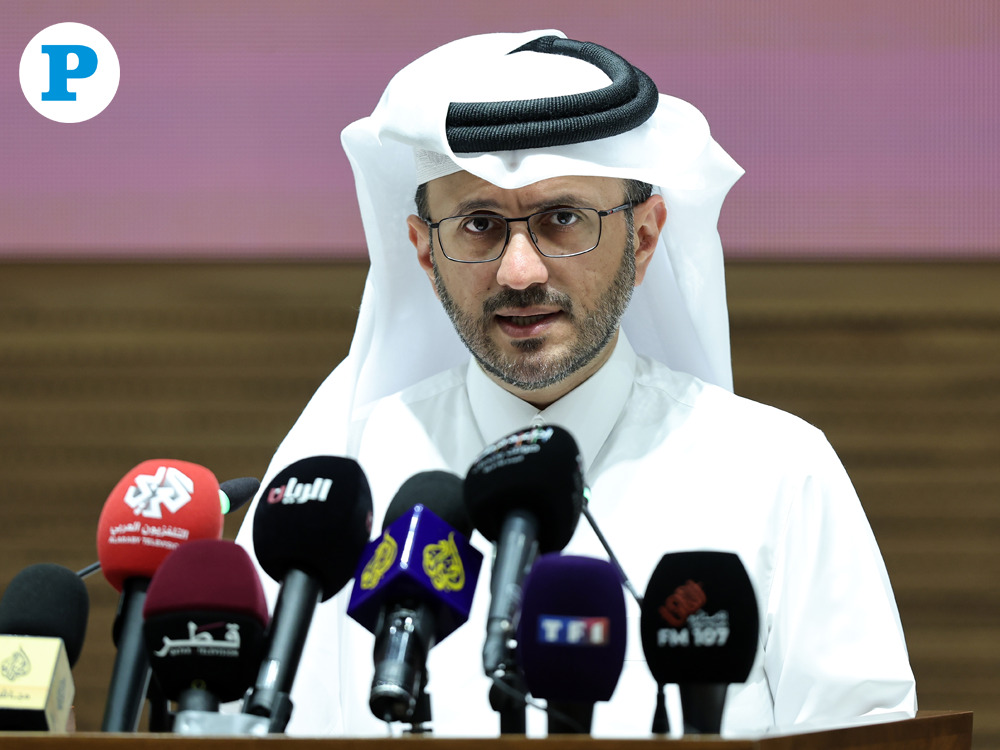
Doha: Advisor to the Prime Minister and Official Spokesperson for the Ministry of Foreign Affairs Dr. Majed bin Mohammed Al Ansari said Israel’s rejection of the peace plan in the Gaza Strip represents a continuation of its foot-dragging in implementing the agreements that have been reached since day one to reach a ceasefire.
He added that the State of Qatar hopes that the international community would exert pressure that culminates in implementing the second phase of the accord.
During the weekly press briefing of the Ministry of Foreign Affairs, Dr. Al Ansari stated that the recent declaration by the Hamas movement has helped achieve a breakthrough in the agreement. He pointed out that the responsibility right now lies on the Israeli side to live up to its obligations.
The State of Qatar continues to work with its partners in the international community to ensure the transition to the second phase of the ceasefire agreement based on the plan declared by the US President, Dr. Al Ansari noted.
Dr. Al Ansari clarified that the State of Qatar continues its mediation efforts in lockstep with the United States of America, the Arab Republic of Egypt and the Republic of Turkiye. He recalled that the field escalation in the Gaza Strip and the West Bank is still dragging on, amid the increasing numbers of martyrs and the relentless attacks on schools, civilian institutions, hospitals and homes.
The Official Spokesperson stressed the importance of the international community taking a conspicuous position toward these actions, re-emphasizing that the State of Qatar is working with its regional partners to crystallize a reaction that is proportionate to the relentless Israeli behavior.
In regard to the joint statement on the Israeli continuous violations in the Gaza Strip, Dr. Al Ansari asserted that the State of Qatar backs all measures undertaken by friendly nations, whether individually or collectively.
Dr. Al Ansari recalled the statement issued by the foreign ministers of the State of Qatar, the Hashemite Kingdom of Jordan, the United Arab Emirates, the Republic of Indonesia, the Islamic Republic of Pakistan, the Republic of Turkiye, the Kingdom of Saudi Arabia, and the Arab Republic of Egypt. He revealed practical steps that would be announced in the days ahead.
On the visit of HM Sultan Haitham bin Tarik of the brotherly Sultanate of Oman to the State of Qatar, and whether it had new messages or initiatives for de-escalation in the region, Dr. Al Ansari highlighted that the current phase is a watershed moment in the path of the negotiations between the United States of America and the Islamic Republic of Iran.
He lauded the Sultanate of Oman's efforts in this regard, re-emphasizing the State of Qatar's support for endeavors toward de-escalation.
Dr. Al Ansari outlined the State of Qatar's effective engagement in the efforts aimed at de-escalating tensions between the United States of America and the Islamic Republic of Iran, affirming that Qatar follows up on the progress made in the ongoing talks between the Sultanate of Oman and Iran.
The minimum threshold required at this current phase lies in the restoration of freedom of navigation through the Strait of Hormuz in alignment with the provisions of international law, the Official Spokesperson said.
Regarding the Makkah Joint Defense Agreement between the Kingdom of Saudi Arabia, the Republic of Turkiye, and the Islamic Republic of Pakistan, Dr. Al Ansari welcomed any regional cooperation that helps strengthen security and stability in the region.
Dr. Al Ansari pointed out and recalled the close strategic ties between the State of Qatar and those three nations, affirming that Doha positively looks at any defense framework that is based on cooperation and good-neighbor relations.
He further stressed that the security of the region is a collective responsibility that requires further bilateral and regional coordination among countries of the region, noting the existence of several regional platforms in which the State of Qatar participates to foster cooperation and close coordination.
Regarding his take on the impact of the American economic pressures on Iran and their implications for de-escalation efforts, Dr. Al Ansari clarified that the priority right now is to reopen the Strait of Hormuz and support the current path of negotiations, reaffirming that talks among relevant parties are still ongoing.
Any delay in reaching an accord does not serve stability efforts, Dr. Al Ansari underlined, indicating that the State of Qatar, in its capacity as a contributing party to the mediation efforts, seeks to reopen the Strait right away, while leaving official remarks and declarations with respect to the negotiations to the relevant parties.
With respect to the Gulf position on the Iranian remarks concerning the Strait of Hormuz, Dr. Al Ansari emphasized that this position lies in the clamor for restoring the situation at the Strait to what it had been before the crisis erupted.
Dr. Al Ansari stressed that what matters more is to ensure freedom of maritime navigation, suggesting that Qatar's support for any regional understandings would help protect the security of the Strait, as well as freedom of navigation based on international law.
Qatar, he said, sees that any future arrangements pertaining to the management of the Strait or other relevant matters should be based on regional concurrence and full respect for international law to safeguard the security and stability of the region.