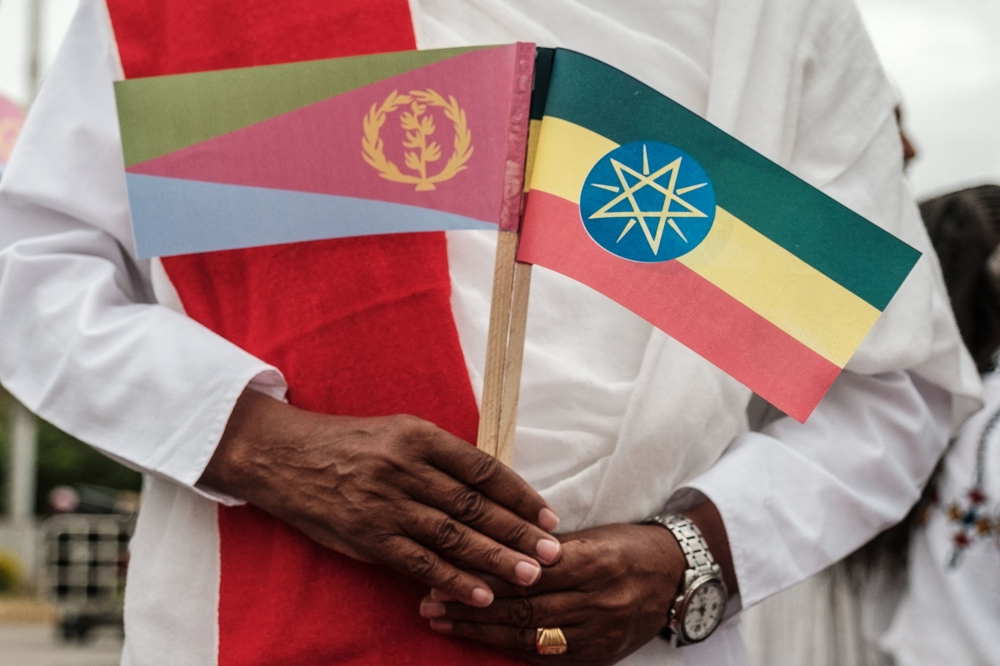
In this file photo taken on November 09, 2018 a man holds National flags of Eritrea (left) and Ethiopia as he waits for the arrival of Eritrea's President at the airport in Gondar, nothern Ethiopia. (Photo by EDUARDO SOTERAS / AFP)
Addis Ababa: The governments of Ethiopia and Eritrea on Tuesday angrily rejected US claims their forces had committed war crimes and crimes against humanity during the devastating two-year war in Tigray.
Ethiopia's foreign ministry branded the allegations made by US Secretary of State Antony Blinken on Monday as "partisan" and "inflammatory".
And several hours later, the Eritrea foreign ministry issued a statement describing them as "unsubstantiated and defamatory".
Blinken, who last week made his first visit to Ethiopia since a November 2022 peace deal silenced the guns in northern Ethiopia, accused all parties to the conflict of committing war crimes.
But he singled out Ethiopian, Eritrean and regional Amhara forces for crimes against humanity, without mentioning the rebel Tigray People's Liberation Front (TPLF).
Blinken said the State Department had carried out a "careful review of the law and the facts" and concluded that war crimes were committed by federal troops from both Ethiopia, its ally Eritrea and Amhara as well as the TPLF.
"Many of these actions were not random or a mere byproduct of war. They were calculated and deliberate," Blinken said as he presented an annual human rights report.
He said the State Department also found crimes against humanity by Ethiopian, Eritrean and Amhara forces, including killings and sexual violence, although he did not mention the TPLF.
Ethiopia's foreign ministry said the US statement "unfairly apportions blame among different parties in the conflict".
"The statement appears to exonerate one party from certain allegations of human rights violations such as rape and other forms of sexual violence despite the clear and overwhelming evidence about its culpability," it said.
"This partisan and divisive approach from the US is ill-advised," it added, calling it "unwarranted".
Asmara issued a similarly strong statement, saying the US allegations constituted a "continuation of unwarranted hostility and demonisation that US administrations have pursued against Eritrea since 2009 to advance their ulterior political agendas".
The foreign ministry charged that a "litany of TPLF's crimes... were deliberately downplayed and glossed over" by the United States.
TPLF officials did not respond to AFP requests for comment about the US report.
Blinken had called for accountability during his trip to Addis Ababa, where he held an unusually long meeting with Prime Minister Abiy Ahmed and spoke separately with senior TPLF leader Getachew Reda.
But he did not directly mention war crimes or crimes against humanity and sounded upbeat about the prospects for peace during his visit.
The conflict badly soured US relations with Ethiopia, Africa's second most populous nation and long one of Washington's major partners on the continent.
Abiy had earlier voiced anger when Blinken during the war spoke more generally about crimes against humanity, and the Ethiopian leader has rejected UN-led efforts for a probe.
On Tuesday, the foreign ministry said Washington's statement "undercuts the support of the US for an inclusive peace process".
The United States has estimated that some 500,000 people died in the two-year conflict, making it one of the deadliest wars of the 21st century and dwarfing the toll from Russia's invasion of Ukraine.
The war began in November 2020 when the TPLF, once the major powerbroker in Ethiopia, attacked military installations in the Tigray, triggering a major counter-offensive.
As allegations of atrocities mounted, the US imposed sanctions on Eritrea, an authoritarian state whose relations with Washington were already poor, and booted Ethiopia from a major trade pact, although it held back on further action against the warring parties.