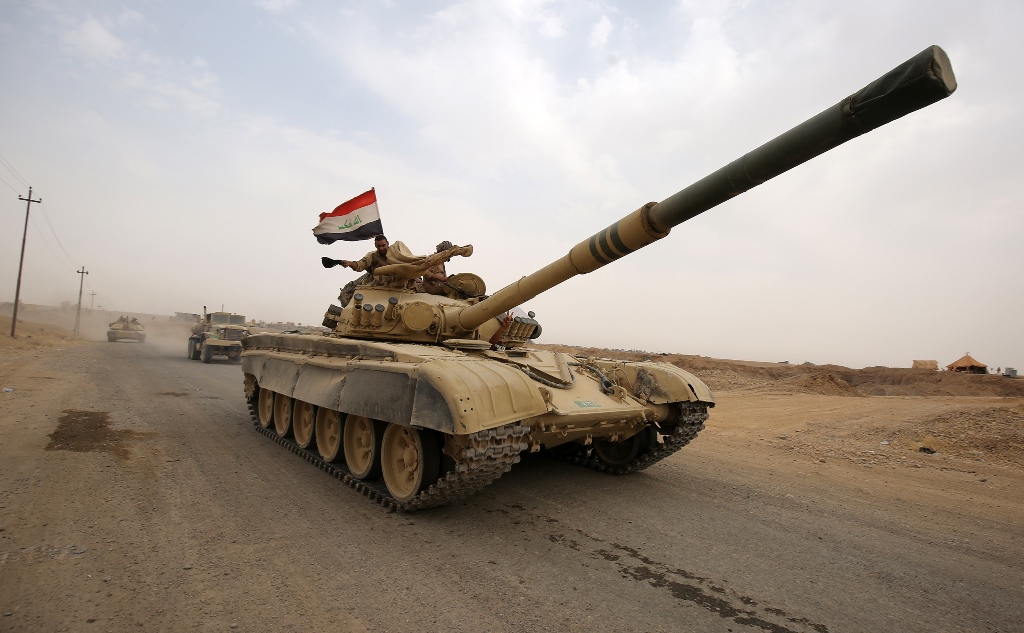
An Iraqi soldier waves his hat from the turret of a Russian-made T-72 tank, as Iraqi forces advance towards the city of al-Sharqat on September 20, 2017, where Iraqi forces backed by Hashed al-Shaabi (Popular Mobilisation) paramilitaries are preparing to
Baghdad: The area around the Iraqi town of Hawija, where the Islamic State group came under attack by Iraqi forces Thursday, has been an insurgent bastion since soon after the US-led invasion of 2003.
Its mainly Sunni Arab population is deeply hostile both to the Shiite-led government in Baghdad and to the Kurds who form the historic majority in adjacent areas.
Those rivalries have enabled IS to cling on in what is now one of just two enclaves it still holds in Iraq.
'Kandahar in Iraq'
Hawija earned the nickname of "Kandahar in Iraq" from US-led coalition troops after the 2003 invasion for the ferocious resistance it put up similar to that in the Taliban militia's bastion in Afghanistan.
The town saw a string of major coalition operations that fuelled resentment, targeting both fugitive members of Saddam Hussein's regime and insurgent leaders.
Like the rest of Iraq's Sunni Arabs, who dominated the country under Saddam and all previous regimes, there was widespread resentment at the minority's loss of power under Shiite-led governments in Baghdad.
Deadly clashes erupted in 2013 when Shiite-dominated security forces smashed up a protest camp set up to demonstrate against perceived anti-Sunni discrimination.
The fighting, in which more than 50 people were killed, was a key event in a surge in sectarian violence that culminated in the IS offensive that overran swathes of the country the following year.
Ethnic fault line
Located west of the ethnically divided Kurdish-held city of Kirkuk, Hawija also lies on a fault line of Arab-Kurdish tensions.
The area lies in Kirkuk province and its Sunni Arab population is bitterly opposed to Kurdish ambitions to incorporate the province in their autonomous region in the north.
After IS seized much of northern Iraq in a lightning 2014 assault, Kurdish peshmerga forces launched a counter-offensive that left them in control of most of the rest of Kirkuk province.
Preparations for the offensive in Hawija have been overshadowed by an independence referendum that Kurdish leaders plan to hold on Monday in areas including Kirkuk against the wishes of the federal government in Baghdad.
Strategic prize
The Hawija area is one of just two enclaves in Iraq still held by IS and its long-awaited recapture would mark a major symbolic and strategic victory for the government.
The town lies between the two main routes north from Baghdad -- to second city Mosul, recaptured from IS in July, and to Kirkuk and the autonomous Kurdish region.
Security forces backed by paramilitary units launched an assault on the jihadists' other Iraq pocket earlier this week, thrusting up the Euphrates Valley towards the Syrian border in a bid to retake three towns there still held by IS.