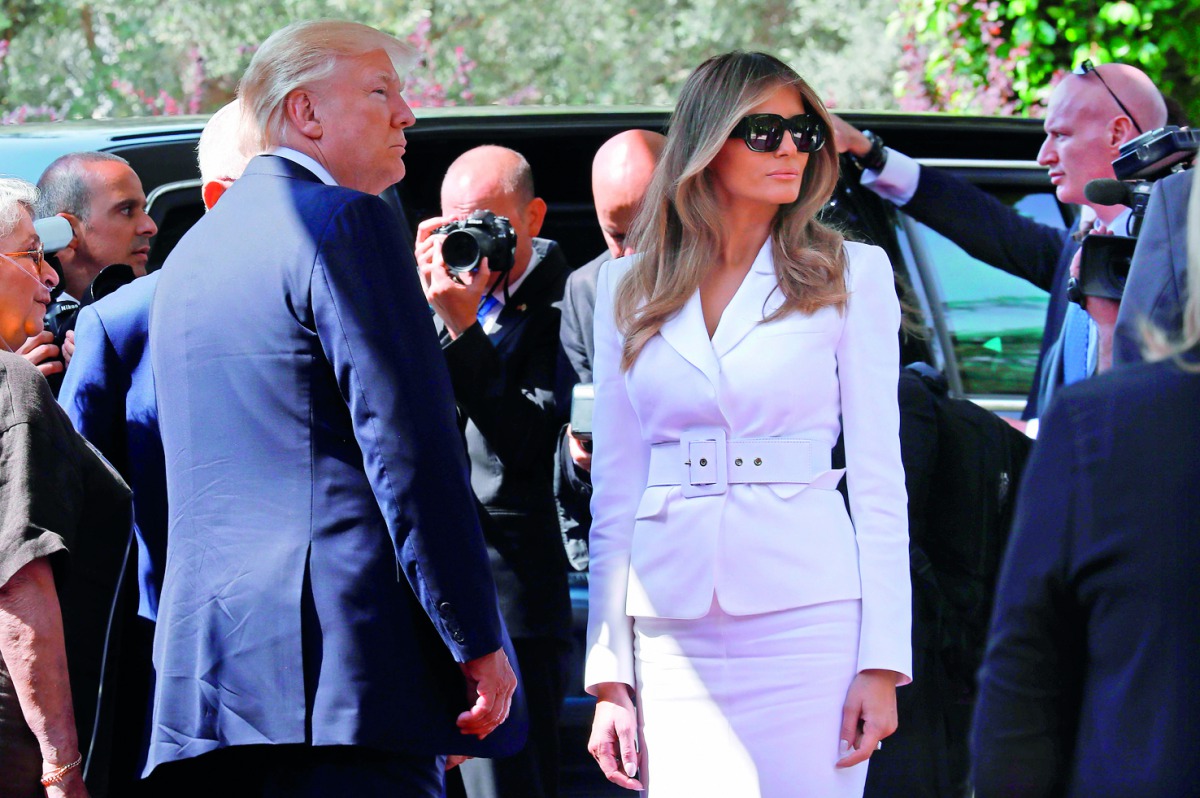
US President Donald Trump and US First Lady Melania Trump arrive at the Israeli President's Residence in Jerusalem, yesterday. Melania Trump (seated right) talk to children during a visit to the Hadassah Ein Kerem hospital in Jerusalem, yesterday.
Jerusalem: US President Donald Trump began his first visit to Israel yesterday, saying he sees growing recognition among Muslim nations that they share a "common cause" with Israel in their determination to counter the threats posed by Iran.
Arriving directly from Riyadh, Saudi Arabia, Trump expressed his hope for cooperation among US allies in the Middle East. "We have before us a rare opportunity to bring security and stability and peace to this region and to its people," Trump said upon his arrival in Tel Aviv.
Trump's first stop was a meeting in Jerusalem with Israeli President Reuven Rivlin. In a statement following the meeting, Trump addressed his meetings the previous day with Arab and Muslim leaders in Saudi Arabia, and said that there is growing realisation that they share a "common cause with you" in their determination to defeat extremism and deter "the threat posed by Iran."
Trump became the first sitting president to visit the Western Wall. Today, he is set to meet with Palestinian President Mahmoud Abbas in the West Bank and deliver a speech.
White House aides have also tried to play down expectations for significant progress on the peace process during Trump's stop, casting the visit as symbolic. US Secretary of State Rex Tillerson referred to the visit as "a moment in time" and suggested that the US would take a more active role in the future in brokering a deal if both sides make serious commitments.
Trump, whose unorthodox approach has spurred some hope on both sides of the Israeli-Palestinian conflict, has done no such managing of expectations. He boldly stated that achieving peace is "something that I think is, frankly, maybe not as difficult as people have thought over the years" in March during a meeting with Palestinian President Mahmoud Abbas. "But we need two willing parties," he said then. "We believe Israel is willing. We believe you're willing. And if you both are willing, we're going to make a deal."
Trump is seeking to ease concerns that his policies wouldn't be as beneficial to Israel as once believed. He has taken a tougher line on settlements than Israeli officials had believed, urging restraint but though not calling for a full halt to construction. Trump has also retreated from a campaign pledge to move the US Embassy in Israel from Tel Aviv to Jerusalem, bending to the same diplomatic and security concerns as other presidents who have made similar promises.
Palestinians, who viewed Trump's victory with some trepidation, are said to have been pleasantly surprised by Trump's openness during a recent meeting with Abbas in Washington.
In remarks at Israeli President Reuven Rivlin's residence, Trump launched another salvo against Iran. "The United States and Israel can declare with one voice that Iran must never be allowed to possess a nuclear weapon — never ever — and must cease its deadly funding, training and equipping of terrorists and militias," Trump said.
"And it must cease immediately."
When meeting Israeli Prime Minister Benjamin Netanyahu, Trump said Iran should have thanked the United States for the 2015 nuclear accord between Tehran and world powers because it led to the lifting of sanctions.
"Instead of saying thank you to the United States, they now feel emboldened," Trump said.