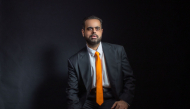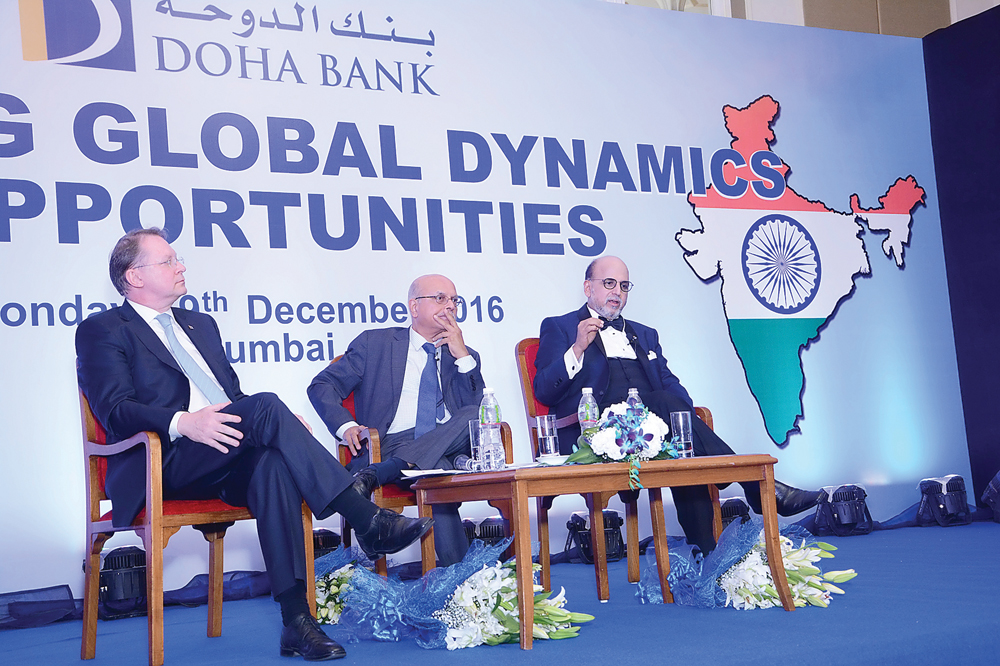
Dr R Seetharaman (right), CEO of Doha Bank, speaking at the "Changing Global Dynamics and Opportunities” event held in Mumbai recently.
On the occasion of the bank’s “International Offices’ Meet” Doha Bank hosted a knowledge sharing session “Changing Global Dynamics and Opportunities” recently in Mumbai. The event was attended by key management staff from leading Corporates, prominent bankers and SMEs from the western Indian state of Maharashtra.
The event commenced with the key note speech by Suresh Prabhu, Minister of Railways, Government of India. The Minister recalled the historical bond between India and GCC countries and with Qatar in particular. He emphasised that Qatari capital and Indian Entrepreneurship would go very well hand in hand for setting up commercially viable projects and such a coordination between the two countries would be very beneficial for both countries.
This was followed by a presentation from Shailesh Haribhakthi, Chairman, DH Consultant Pvt Ltd and a member of the local advisory board for Doha Bank in India on “demonetisation and its impact”.
Shailesh visualised what would be India in the year 2035 after the impact of demonetisation and other reforms launched by the Indian government so far. He firmly believed that there would not be any cash transaction in India as the entire country would go digital and India would grow rapidly with the benefits of reforms.
Speaking on the occasion, Dr R Seetharaman, CEO of Doha Bank, gave insight on global scenario, and said: “The recent IMF outlook had given global growth of 3.1 percent in 2016. A more subdued outlook for advanced economies following the June UK vote in favor of leaving the European Union (Brexit) and weaker-than-expected growth in the United States. As a result, the 2016 growth forecast for advanced economies has been marked down to 1.6 percent.”
He added: “Emerging and developing economies expected to grow by 4.2 percent this year. Last week the Federal Reserve raised its benchmark interest rate for just the second time since the financial crisis of 2008 and have predicted three rate increases in 2017. Most of the GCC central banks have hiked the interest rates in response to Fed’s Action. Policy makers in Saudi Arabia, the United Arab Emirates, Kuwait, Bahrain and Qatar raised borrowing costs within hours after the Fed raised its benchmark rate for the first time this year.”
Speaking about the Indian economy, Seetharaman, said: “According to IMF October 2016 forecast, India is expected to grow by 7.6 percent in 2016-17. India current account deficit could fall below 1 percent in 2016-17. India’s fiscal deficit expected at 3.5 percent of GDP in 2016-17. Consumer prices rose 4.2 percent in from a year earlier in October 2016. The recent demonetization reform is a short term pain but will be a long term gain for Indian economy, it is a step in the right direction towards more transparency, governance and ease of doing business. Foreign Direct Investment (FDI) inflows into India in 2015-16 was $55.4bn.”
Commenting on GCC-India bilateral relationships. He said: “GCC – India bilateral trade stood close to $100bn in 2015-16. In Feb 2016 India and the United Arab Emirates (UAE) signed a wide-ranging set of seven agreements, including on cyber security, infrastructure investment and insurance. GCC Sovereign Wealth funds can look forward to participate in India’s infrastructure development. UAE and India have agreed to collaborate closely to identify bottlenecks to trade and new areas of trade with the aim of increasing two way trade by 60 per cent in five years while significantly boosting investment. The new goal set by both sides is to boost trade by 60 per cent by 2020.”