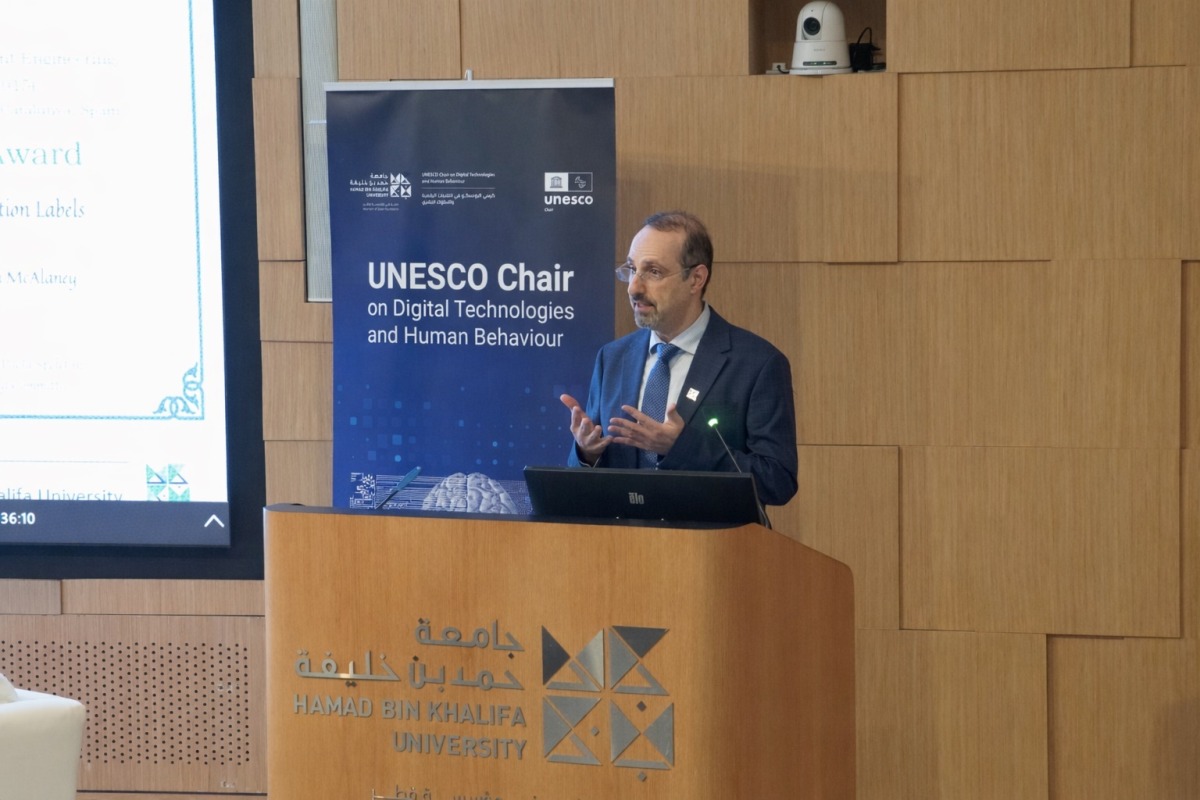
Professor at HBKU and Unesco Chairholder Dr. Raian Ali
Doha, Qatar: The four-year Unesco Chair in Digital Technologies and Human Behavior at Hamad Bin Khalifa University brings together research, education, international collaboration, and public engagement to examine how digital technologies are shaping human behaviour in the age of Artificial Intelligence.
The Unesco Chair in Digital Technologies and Human Behavior is hosted by the university’s College of Science and Engineering (CSE) and runs from June 2025 to June 2029 under the Unesco Chairs Programme. It will deliver multinational research projects, capacity-building activities, public outreach campaigns and international events, with outcomes designed to inform education and technology policy both in Qatar and globally.
Professor at HBKU and Unesco Chairholder Dr. Raian Ali said the programme seeks to ensure that rapid digital transformation remains aligned with human values and societal needs.
“The Unesco Chair in Digital Technologies and Human Behavior brings together research, development, education and outreach to better understand and enhance how digital technologies shape human behaviour,” he told The Peninsula.
“Our aim is not only to study digital well-being and problematic dependency on technology, but also to examine broader patterns of online and cyber behavior, particularly in the context of intelligent systems and emerging Generative AI technologies.”
At the core of the Chair’s work is the role of technology design. According to Dr Ali, digital systems can either foster healthy, constructive engagement or contribute to harmful and excessive use, often described as digital addiction.
“We are particularly interested in how design choices influence user behaviour,” he explained. “Systems can be built to support positive engagement, or they can unintentionally and sometimes intentionally encourage compulsive use. Understanding that difference is central to our research.”
The Chair will conduct multi-national studies exploring the intersection between technology design, especially Artificial Intelligence and Generative AI and human behaviour. These studies include large-scale cross-country surveys, controlled experiments testing specific design features, and evaluations of emerging technologies.
“We examine how people interact with AI systems and how these interactions influence decision-making, learning, health and social well-being,” Dr Ali said. “At the same time, we develop and test innovative solutions, whether through improved design principles, broader socio-technical interventions, or critical digital literacy programmes.”
He described this dual approach of evaluating current technologies while proposing better alternatives – as essential to ensuring technological progress benefits society.
Among the key challenges the Chair will address are digital well-being, digital addiction, cyberbullying and misinformation. Particular attention will be paid to the Arab family context, recognising that cultural and social dynamics significantly shape technology use.
“We are studying the emerging and complex relationship between AI systems and issues such as dependency, exposure to misinformation and social comparison,” Dr Ali said. “In addition, digital parenting is a major focus. Child behaviour is shaped by the family environment, so meaningful change requires a family-centred approach that works with parents and the wider family context.”
In practical terms, digital well-being, he noted, goes beyond limiting screen time.
“Digital well-being means using technology in ways that support positive emotions, meaningful engagement, healthy relationships and personal growth,” he said. “It is about technology helping people thrive rather than distract or overwhelm them.”
He added that achieving digital well-being is a shared responsibility. “It is not only about how users behave. It is also about how technologies are designed, what literacy skills people are given, and what policies guide development and deployment. Users, designers, institutions and policymakers all have a role.”
Ethics is another pillar of the Chair’s mandate. Dr Ali emphasised that responsible technology design must embed transparency, accountability and user empowerment from the outset.
“Ethically grounded technology should be built with well-being enhancement and harm reduction in mind,” he said. “Responsible design should make users more informed and conscious of their interactions, and include mechanisms that gently guide individuals who show signs of problematic or addictive use toward more balanced engagement.”
The Unesco Chair is supported by a network of collaborators spanning more than 15 countries, enabling cross-national studies on AI attitudes, dependency on large language models, and the educational and well-being impacts of Generative AI. Local partners in Qatar will facilitate nationwide research to better understand emerging digital challenges and provide evidence-based insights to policymakers, educational institutions and industry stakeholders.
“These partnerships ensure that our research is globally informed, culturally sensitive and directly relevant to policy and practice,” Dr Ali said.