The weak economic environment will continue weighing on the financial profiles of banks in the Gulf Cooperation Council (GCC) countries in 2017 and 2018, said S&P Global Ratings yesterday.
The end of the commodities super-cycle resulted in a significant slowdown of the GCC economies and reduced growth opportunities for their banking systems. S&P assumes that oil prices will stabilize at $50 per barrel in 2017 and 2018, and forecast unweighted average economic growth for the six GCC countries of 2.2 percent in 2017 and 2.5 percent in 2018.
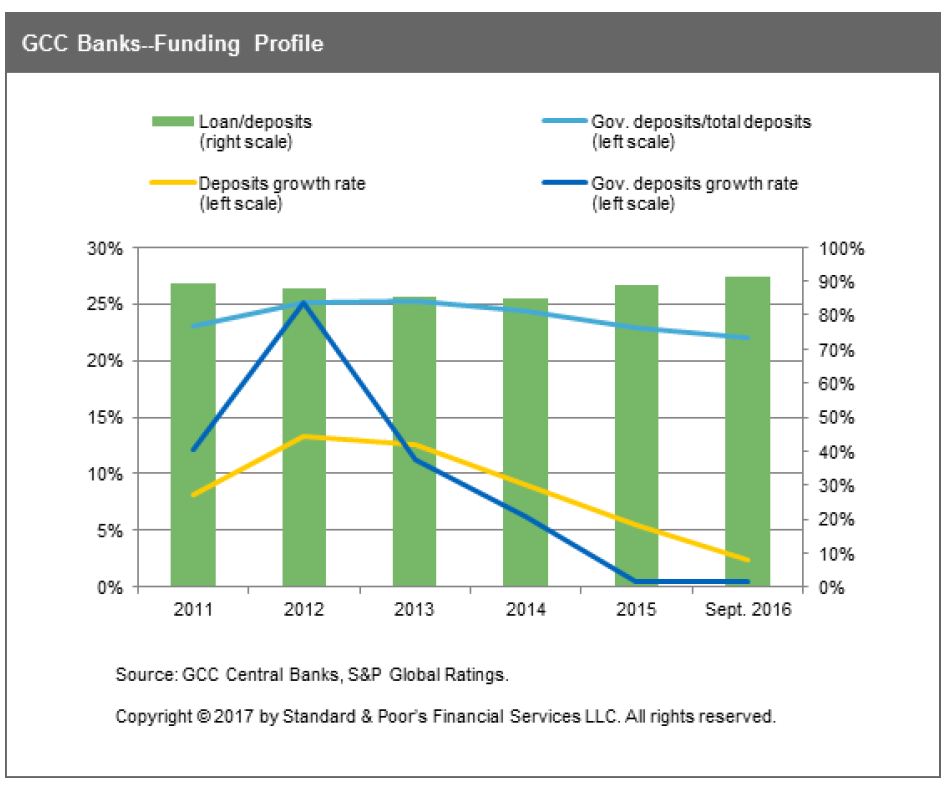
"The end of the commodities super-cycle has resulted in a significant decline in the economic prospects of the GCC region, implying lower growth opportunities for its banking systems and deteriorating liquidity," said S&P global Ratings credit analyst Mohamed Damak, "and the end of the commodities boom has also increased the pressure on GCC banks' asset quality and profitability indicators.
Although S&P expects to see further weakening in some of these indicators in 2017-2018, we think that GCC banks have built sufficient buffers to make the overall impact on their financial profiles manageable.
Rated banks in the GCC continued to display good asset quality indicators, profitability, and capitalization in 2016 by global standards, albeit with signs of deterioration from 2015. Over the past year, we have taken several negative rating actions on banks in the GCC. Most of these were concentrated in Bahrain, Oman, and Saudi Arabia. Overall, 31 percent of S&P’s rated banks in the GCC have negative outlooks or are on CreditWatch with negative implications.
Growth in lending to the private sector halved to 5 percent on average as of September 30, 2016, compared with 10 percent in 2015. In 2017-2018, we expect this situation to continue as the government's policy response to lower oil prices continues to take the form of spending cuts and the postponement of infrastructure projects.
Under S&P’s base-case scenario, it expects private sector lending growth to reach 5 percent-7 percent on average for the banking systems of the six GCC countries for 2017-2018, supported by strategic initiatives such as the Dubai Expo 2020, the World Cup 2022 in Qatar, and the ongoing increase in government spending in Kuwait.
The greater exposure of some banks to the real estate sector, specifically some of the large Islamic banks, is also a factor to watch in the current asset quality cycle, specifically for the Kuwaiti, Omani, and the UAE markets. Under its base-case scenario, the ratings agency thinks that NPLs could increase to 4 percent-5 percent over the next two years and credit losses could double over the same period. The adoption of IFRS9 is also likely to increase GCC banks' cost of risk in 2017-2018.
“GCC banks continue to display strong capitalization by international standards, with an unweighted average S&P Global Ratings risk-adjusted capital (RAC) ratio of 11.8 percent at year-end 2015. We note, however, that capitalization has dropped over the past two years, from an average of 12.5 percent at year-end 2013, as rapid growth of financing has not been matched by additional capital raisings or conservative dividend payout ratios”, the ratings agency noted.