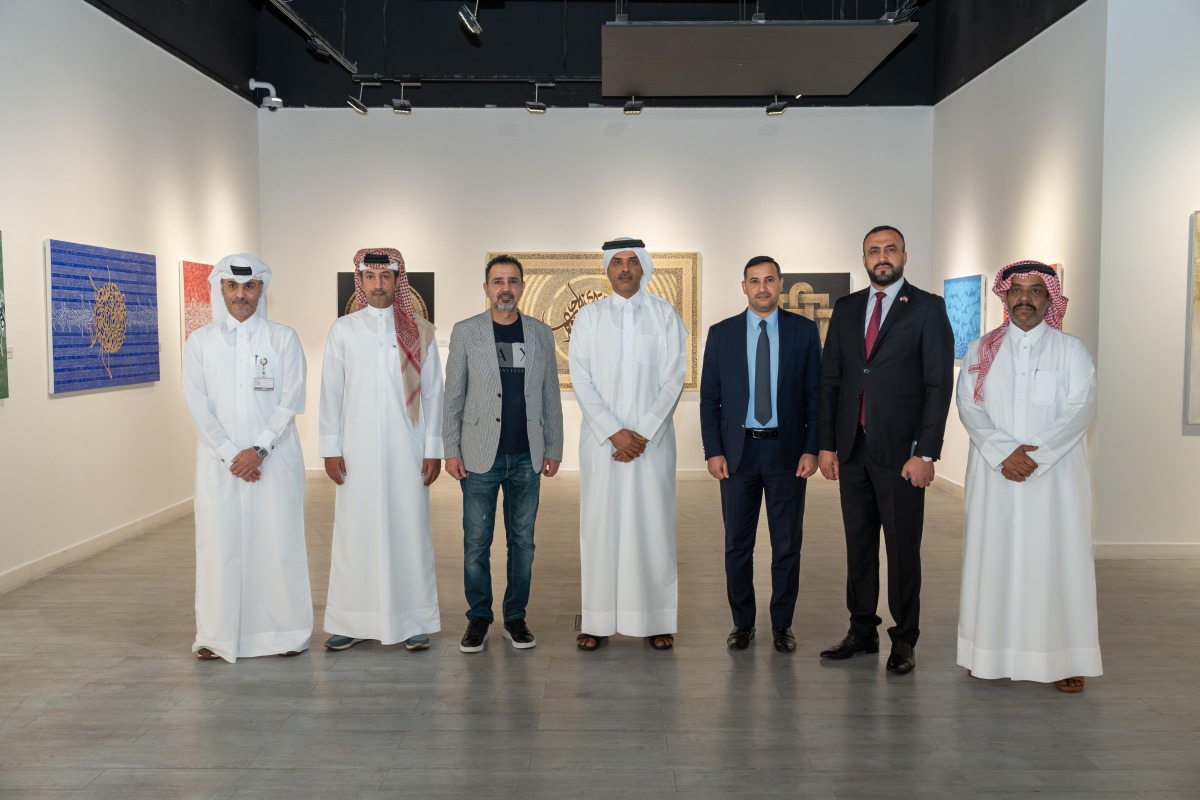
The opening was attended by Deputy General Manager of Katara Saif Saad Al-Dosari along with a number of interested individuals, artists, and media representatives.
Doha, Qatar: The “On the Shoulder of the Letter” exhibition by Iraqi artist Diaa Al-Jazairi opened yesterday evening at the Katara Cultural Village Foundation.
The opening was attended by Deputy General Manager of Katara Saif Saad Al-Dosari along with a number of interested individuals, artists, and media representatives. The exhibition presents an artistic experience that celebrates the Arabic letter as a carrier of memory and a visual voice of ancient Arabic poetry.
This exhibition marks the artist’s first appearance in Qatar. It features 28 paintings, most of which are inspired by the Mu’allaqat (pre-Islamic odes), in a visual approach that blends the spirit of poetry with the aesthetics of the letter.
The works evoke the echoes of the Arabic poem in its original setting, when the poet recited his poem in the desert, in a scene where language intertwines with sound, and rhythm with memory. In a statement, artist Diaa Al-Jazairi expressed his delight at holding his first exhibition in Qatar, emphasizing that Katara is a prestigious cultural landmark that every artist is keen to showcase their work in, given its high artistic and cultural standing. He noted that completing the paintings for the exhibition took nearly three years of work, a profound research and visual exploration of poetic text and Arabic calligraphy.
Al-Jazairi explained that the exhibition’s concept is based on evoking the poetic moment within its historical and emotional context. He treated the letter not merely as a linguistic medium, but as a living entity moving within the painting, carrying the echo of sound and recapturing the spirit of recitation. He added, “I tried to make the letter move, to make it pulsate, to narrate in its own way the state the poet experienced while reciting his poem—that fusion of pride, wisdom, longing, and pure human emotion.” The paintings transcend the traditional presentation of texts, offering a philosophical visual reading of poetry. The poem transforms into a visual space, and the letter is liberated from its linear structure to become an independent visual element, retaining the spirit of meaning without being bound by it.
It is worth noting that the exhibition is open to visitors throughout Ramadan, from 10am to 10pm, in Building 18, Hall 2. Meanwhile, the “Interactive Experience in Arabic Calligraphy and Ornamentation” workshop, led by artist Aisha Rabai, commenced, garnering significant attention and a remarkable turnout from calligraphy enthusiasts. The workshop provided a vibrant space for direct interaction with the aesthetics of Arabic calligraphy, where participants engaged in a practical experience combining visual knowledge with artistic application in an inspiring and creative atmosphere.
The workshop reinforced the presence of Arabic calligraphy as a living art form, capable of renewal and interpretation. It also provided participants with an opportunity to discover the aesthetic and decorative dimension of the craft, and to learn about its techniques and structures, thus reinforcing awareness of its artistic and cultural value.