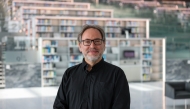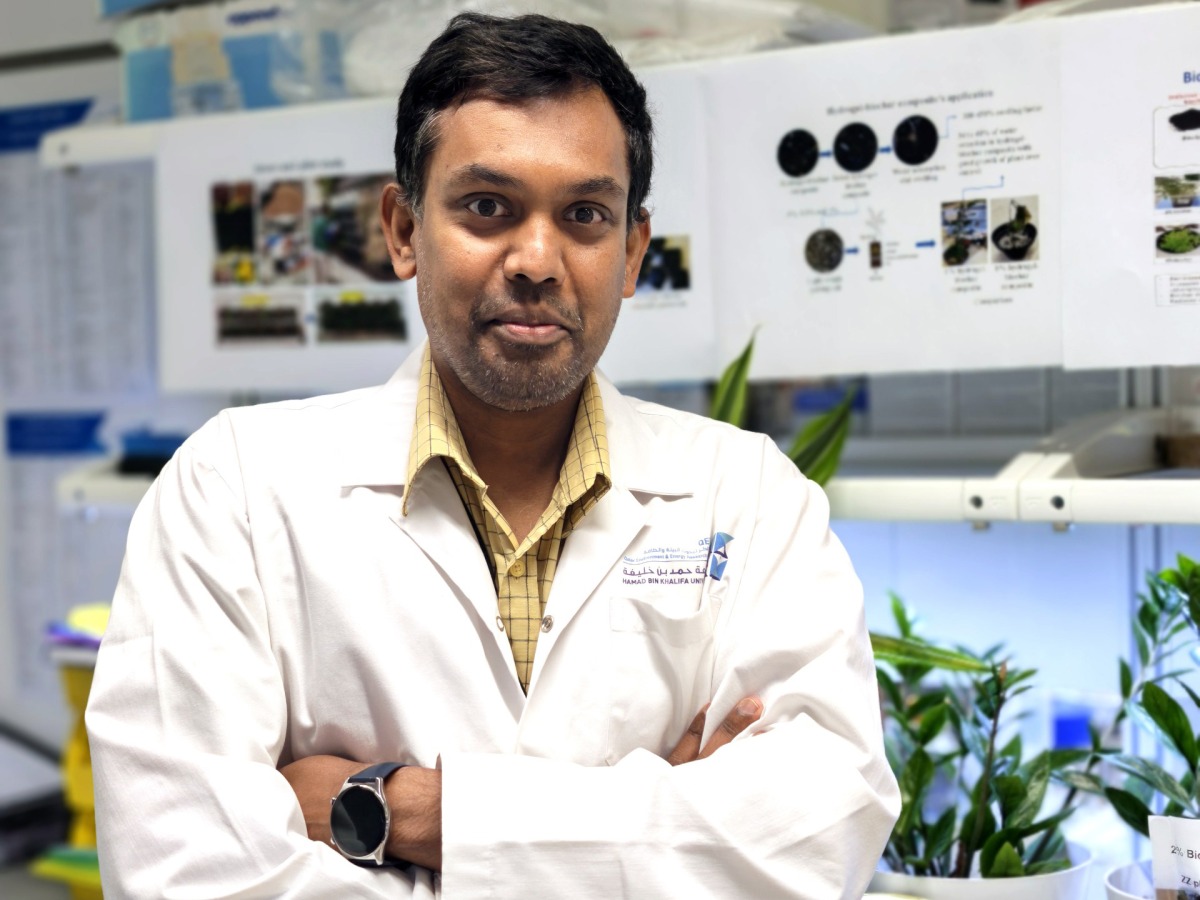
Jayaprakash Saththasivam, Senior Scientist at the Water Center of the Qatar Environment and Energy Research Institute
Doha: Researchers at Hamad Bin Khalifa University (HBKU) have developed an innovative decentralised wastewater treatment system that could reduce treatment energy consumption by up to 50 percent while transforming wastewater and organic waste into valuable resources for urban greening and agriculture.
The project, known as CURES (Circular Decentralised Systems for Urban Wastewater Treatment, Reuse, and Soil Enrichment), is being led by Dr. Jayaprakash Saththasivam, Senior Scientist at the Water Center of the Qatar Environment and Energy Research Institute (QEERI), part of HBKU. The initiative aims to strengthen Qatar’s water security by treating wastewater close to where it is generated and reusing it safely for non-potable applications.
One of the project’s most significant breakthroughs is the successful testing of a compact membrane aerated biofilm reactor (MABR), which uses beneficial microbes to remove pollutants and excess nutrients from wastewater.
According to Dr. Saththasivam, the technology can achieve effective treatment while using approximately 30 to 50 percent less aeration energy than conventional wastewater treatment systems.
“Fresh water is extremely valuable in a desert country like Qatar,” Dr. Saththasivam told The Peninsula.
“Our goal is to stop thinking of wastewater as waste and start treating it as a valuable resource.”
The CURES project combines advanced biological treatment technologies, living wall systems, and biochar-based materials produced from local organic waste.
Unlike conventional centralised treatment plants, the decentralized approach allows wastewater to be treated near its source, such as farms, residential complexes, academic campuses, or smart city developments.
This enables treated water to be reused on-site for landscaping, urban greening, cooling systems, and, where appropriate, irrigation of fodder crops, reducing reliance on desalinated water supplies.
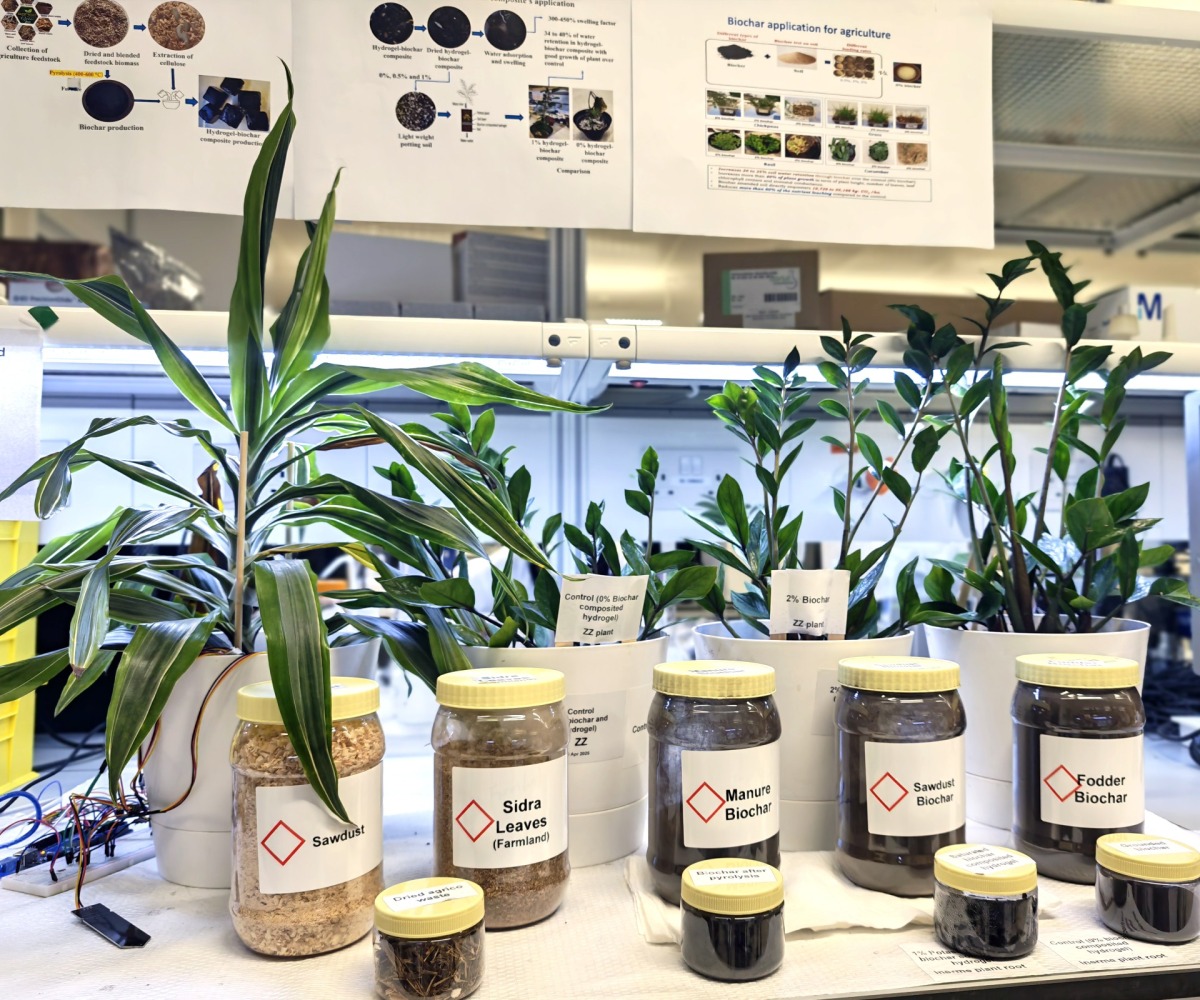
Research conducted by the QEERI team has already demonstrated promising results. Alongside the MABR technology, researchers developed innovative biochar-hydrogel composites capable of holding water and nutrients more effectively than conventional materials.
Tests showed that the composites expanded to more than three times their original size and retained moisture longer than hydrogel alone, making them particularly suitable for Qatar’s hot and arid climate.
The team also evaluated living walls irrigated with greywater under local environmental conditions. Greywater, which originates from sources such as sinks, showers, and washing machines, was further polished through biochar-based growing media that improved water clarity and captured nutrients more efficiently than traditional soil systems.
“The strength of the CURES system lies in combining technology with nature,” Dr. Saththasivam said. “The compact biological treatment unit performs the initial cleaning, while the living wall acts as a natural finishing stage, where plants, microbes, and specially designed media work together to further improve water quality.”
Beyond wastewater treatment, biochar has emerged as a key component of the project’s circular economy approach. Produced from agricultural and landscaping waste, biochar enhances soil water retention and nutrient storage while supporting microbial activity.
In field and laboratory trials, adding biochar increased soil water-holding capacity by up to 30 percent. Pot experiments also recorded a germination success rate of 90 percent in biochar-treated soils, compared with around 60 percent in untreated local farm soils.
Researchers are additionally developing biochar-enriched materials, including biodegradable mulch films and modified biochar composites, designed to reduce water loss and improve crop productivity under arid conditions.
According to Dr. Saththasivam, the project directly addresses one of Qatar’s most pressing environmental challenges: water scarcity.
“Every unit of water reused through this system helps save high-quality water for essential needs such as drinking and household use,” he said. “At the same time, living walls can provide cooling, improve urban aesthetics, and support greener and more resilient cities.”
The next phase of the project will focus on integrating the various components into a complete treatment and reuse system. Researchers plan to evaluate the combined technology using locally relevant wastewater and greywater streams while assessing water quality, nutrient removal, energy efficiency, operational stability, and maintenance requirements.
The project will build on previous outdoor living wall trials conducted at Qatar Foundation and expand collaboration with local farms, landscaping companies, government entities, technology providers, and Education City partners to demonstrate the technology under real-world conditions.
By advancing decentralised water reuse, nutrient recovery, and circular resource management, the CURES project supports the objectives of Qatar National Vision 2030 and the Qatar National Development Strategy, while reinforcing QEERI’s mission to enhance the nation’s long-term water security through science and innovation.
The research is supported through QEERI Internal Funding, the Qatar Research, Development and Innovation (QRDI) Council’s Climate Change and Environment Call, and HBKU’s Thematic Research Grant Programme.