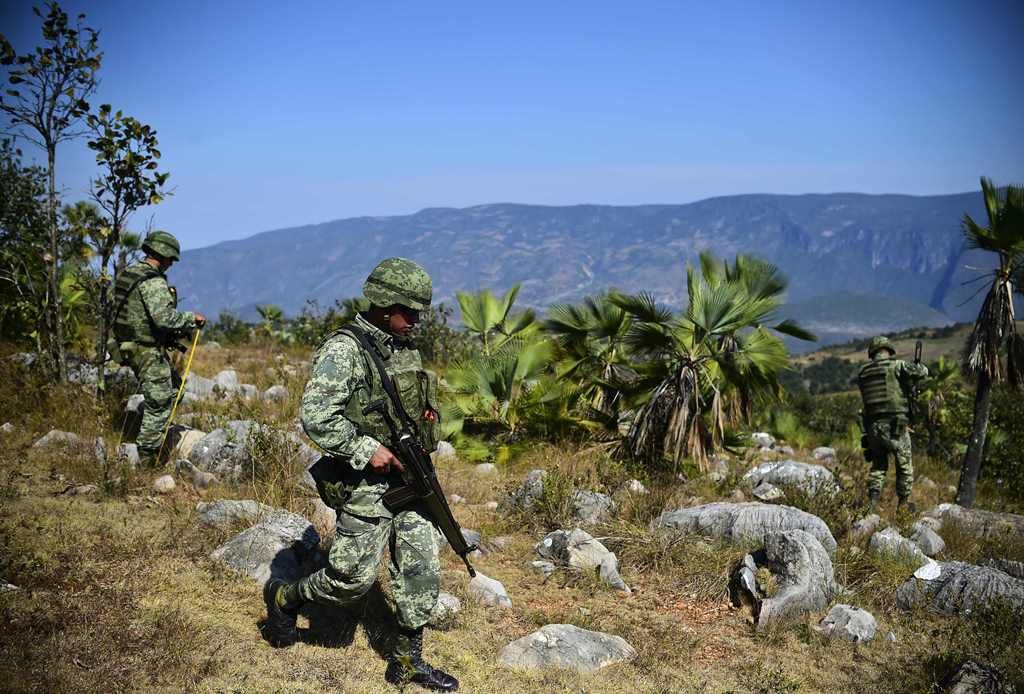
Mexican soldiers search for corpses in the surroundings of a mass grave, in the Zitlala municipality, Guerrero State, Mexico on November 25, 2016. AFP / RONALDO SCHEMIDT
Zitlala, Mexico: At the end of a rocky mountain road lined with pretty fields of corn, marigolds and palm trees, a Mexican drug gang turned a picturesque hill into a gruesome cemetery.
Between Tuesday and Thursday, investigators pulled 32 bodies from 17 shallow graves hidden among small trees and rocks in the southern state of Guerrero. They also found nine heads stored in coolers.
The grim discovery near the village of Pochahuizco, in the municipality of Zitlala, put another dark spotlight on the brutal violence perpetrated by drug gangs battling for supremacy in Guerrero.
For families of scores of people who have disappeared in the area in recent years, it revived fears that their loved ones may have been killed.
A half dozen people flocked to the morgue at the state capital, Chilpancingo, on Friday, only to be told it would take a few days to identify the victims.
"I felt bad, I felt nervous. I don't want to find my husband here. I want to find him alive," said Beatriz Zapoteco, 44, with tears running down her cheeks after leaving the morgue without an answer on Friday.
"I'm here because I want to know if they found my husband there (in the clandestine graves), to rule out the possibility that he died. If they say he's not here (at the morgue), it gives me hope that I will find him alive," Zapoteco, who has three sons and runs a hardware store, told AFP.
On January 5, around seven masked men with assault rifles burst into her home and snatched her husband, Santiago Tixteco, a former town councilman who defended the rights of local farmers.
"That day was as if the world collapsed around me when they kidnapped my husband," said Zapoteco, who doesn't know who took her husband, or why.
Authorities say the Ardillos drug gang and rivals Los Rojos have been battling for control of opium poppy production in the region while both terrorize the population through murders, kidnappings and extortion.
The Rojos have also waged battles with the Guerreros Unidos drug gang, which has been implicated in the disappearance of 43 students in September 2014 in Iguala.
Violence is on the rise: official figures show 1,832 murders have been committed in Guerrero in the first 10 months of this year, compared to 1,651 over the same period in 2015. More than 1,300 people have been reported missing across the state since 2007.
'Hitman's refuge'
Guerrero state security spokesman Roberto Alvarez said investigators believe the horrific camp in Zitlala has existed for years and has probably been used by both gangs, as it exchanged hands depending on who controled the region.
"It's a location used to execute members of a rival gang or keep people who were kidnapped," Alvarez told AFP, adding that it was not yet clear if the field was last used by the Ardillos or the Rojos. "It's a refuge for hitmen."
The site was discovered by soldiers following an anonymous tip. They found a man who was alive with his hands and feet tied among the graves, along with a car, a sport-utility vehicle and a motorcycle, but no criminals.
Soldiers and local police guarded a two-hectare (five-acre) perimeter around the crime scene on Friday. Yellow tape was placed around trees where trash was left by the gang, which was now evidence. Ashes from a camp fire could be seen between the trees, but the graves were 200 meters (yards) further away, hidden behind the plants and trees.
There was evidence that gang members spent time there, including rotting food and empty cans of soft drinks, but no criminals were found or arrested, officials said.
Alejandro Toriz, coordinator of the health department's morgue in Chilpancingo, said the human remains were in various states of decomposition.
Many of the victims found in the pits had been strangled, suffocated, struck violently in the head or their throats were slit, Toriz said. Bloods stains and bullet casings found at the site suggest some were executed on the hill.
The victims included 29 men and three women.
Forensic experts were trying to determine whether the nine heads, which were still "fresh," belonged to nine bodies that were dumped on a roadside near the town of Tixtla last Sunday, he said.
'Skulls and justice'
Jose Diaz Navarro, president of the Siempre Vivos (Always Alive) group of relatives of missing people, said violence surged in 2013 when the Ardillos invaded Rojos territory.
More than 150 people vanished from the neighboring town of Chilapa, he said. A number of people from Zitlala also disappeared.
Navarro's two brothers, cousin and two friends were abducted in November 2014 as they headed to a school construction project. Their headless bodies were found three days later in a roundabout in Chilapa.
The murders of his relatives have left Navarro, a teacher who fled the town after receiving threats, with a grim mission: "We are still looking for their skulls and justice."