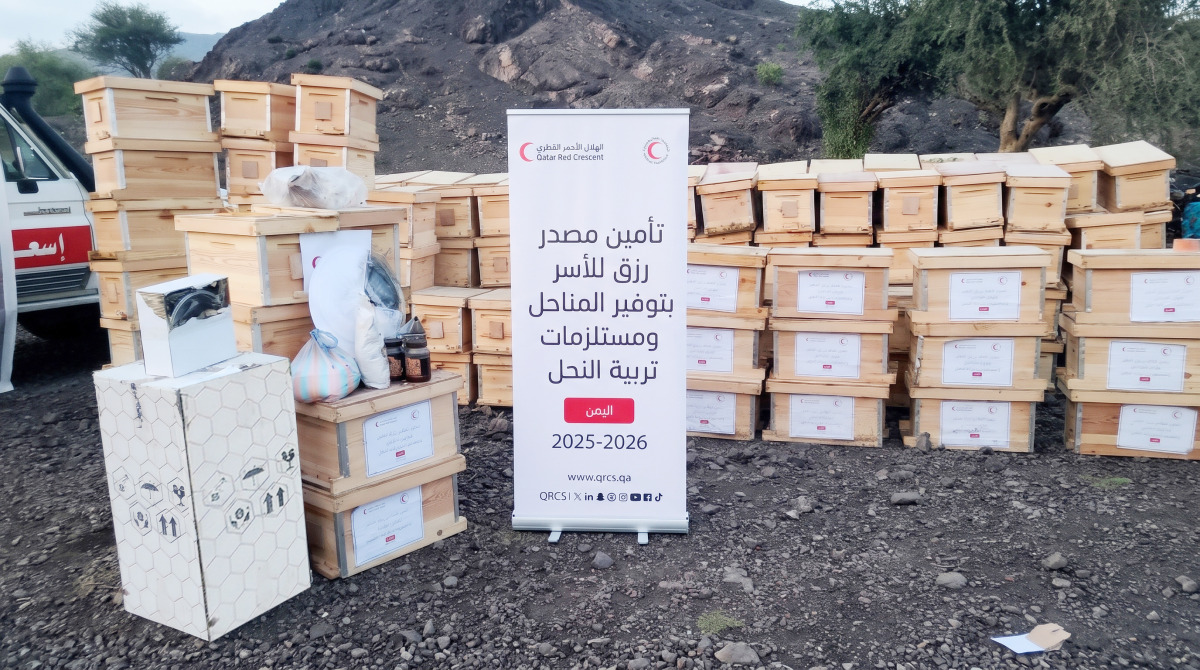
The project provided beekeeping packages to beneficiaries.
Doha: Transforming vulnerable families from aid recipients into self-reliant producers, Qatar Red Crescent Society (QRCS), in partnership with the Yemen Red Crescent Society (YRCS), has implemented the “Securing a Source of Income for Needy Families” project, providing integrated beekeeping packages to 117 households across Hajjah and Amran governorates.
With a total budget of $146,020, the initiative seeks to create sustainable livelihood opportunities, strengthen household resilience, and promote long-term economic stability. The project equipped each beneficiary family with a complete beekeeping package, including 10 beehives, 10 bee colonies, pollen supplements, feeders, honey-production tools, smokers, brushes, honey extractors, and personal protective equipment.
To ensure the project’s sustainability and maximise its impact, beneficiaries underwent specialised training covering modern beekeeping practices, apiary management, and honey harvesting techniques. The training enables participating families to establish small-scale income-generating enterprises and build reliable sources of livelihood.
Director of Al-Madinah District in Hajjah Governorate Mahyoub Saraa praised QRCS for its support, noting that the project empowered 50 families by providing each beneficiary with 10 beehives and the necessary equipment. He described the initiative as a genuine opportunity for vulnerable households to become productive and improve their economic conditions, encouraging beneficiaries to apply the skills they acquired to ensure the project’s success and continuity.
Meanwhile, Director of the Yemen Red Crescent branch in Amran Governorate Ali Al-Azab expressed satisfaction with the project’s outcomes, highlighting the strong engagement shown by beneficiaries throughout the training and implementation phases. He noted that such livelihood interventions are among the most impactful and sustainable humanitarian investments, as they help vulnerable families achieve self-reliance and greater economic security.
He added that beekeeping is particularly well suited to the local environment, offering relatively quick economic returns while supporting honey production and stimulating rural and agricultural development.
In Amran, Hilal Al-Azab, the project coordinator, explained that 67 integrated beekeeping kits were distributed in Suwayr District. He emphasized that the area’s rich vegetation cover and diverse natural forage resources provide ideal conditions for beekeeping, enhancing the project’s prospects for long-term success and sustainability.