A traditional event held as part of Eid celebrations.
Doha, Qatar: Qatar’s enduring folk vocabulary carried forward despite rapid modern change remains viscerally ingrained in the nation’s collective memory, serving as a living archive of ancestral identity, heritage, and long-held traditions passed from generation to generation.
At the heart of this legacy are Qatar’s vibrant folk arts, long considered the cultural heartbeat of Eid celebrations. These traditions have been meticulously preserved through audio-visual recordings archived by the Qatar Media Corporation, as well as through extensive documentation by Qatari heritage scholars, ensuring their survival as a cross-generational cultural inheritance.
Qatar News Agency (QNA) in a report has spoken to several heritage researchers, cultural critics, and musicians who clarified that these folk arts function as a historical record capturing the joy of Eid, firmly rooted in national identity and carried forward as an integral part of Qatar’s cultural DNA.
Writer, journalist, and music critic Ibrahim Al Mutawa noted that Qatar’s and the Gulf’s rich folkloric traditions overflow with time-honoured chants and communal songs tied to life’s major occasions - from Eid and weddings to work, seafaring, and pearl-diving voyages - each with its own artistic signature and expressive style.
He emphasised that the late composer Abdulaziz Nasser played a pivotal, era-defining role in safeguarding this musical heritage, leaving behind iconic works that resonated across the Gulf and the Arab world since the 1970s.
Musicians and heritage researchers note that among the traditional songs worked on by Abdulaziz Nasser, one of the most enduring is “Ya Al-Aido”, which was recorded for Qatar Radio in 1970 and quickly became part of the nation’s cultural soundscape.
They emphasise that Nasser retained the original text and the folk sensibility of the piece while composing a melody deeply rooted in heritage and local tradition, crafting it to reflect the festive spirit of Eid using the well-known “Al-Daza” rhythm, a pattern familiar across Qatar and the Gulf that is commonly performed at weddings and holiday celebrations.
They add that the song achieved widespread popularity and remains a staple of holiday festivities to this day, alongside other folk works that have been documented as part of the Eid celebration repertoire, such as “Bajer Al Eid” and “Al-Aidooh”.
Faisal Al Tamimi, a heritage researcher and composer, said that folk arts reflect past social life including practices professions functions and community roles, affirming that they are associated with specific seasons occasions professions and social customs.
Eid is considered one of the most prominent occasions documented in folk arts. The children’s refrain “Eidkum Mubarak ya Ahl al-Bayt” evolved over time into a traditional folk chant still performed today, he noted.
Heritage researcher and composer Faisal Al Tamimi said that some enthusiasts of folk arts have introduced new rhythmic and melodic elements into traditional forms. While some describe this as modernisation, he avoids that framing, arguing that it is ultimately a matter of taste and audience perception.
He suggests that the most accurate description is “innovation” rooted in traditional foundations.
Al Tamimi noted that Eid Al-Fitr and Eid Al-Adha have long been documented through folk performance traditions, including the women’s “Al-Muradah” chant-dance.
This practice, he says, involves women gathering during Eid in a private setting, performing in two opposing lines, and engaging in unaccompanied call-and-response chanting based on spontaneous, unstructured verses.
Al Muradah is described as a collective performance combining group movement and vocal chanting without instrumental accompaniment, characterised by synchronised footwork, rhythmic swaying, and alternating vocal exchanges between two facing groups, Al Tamimi recalled.
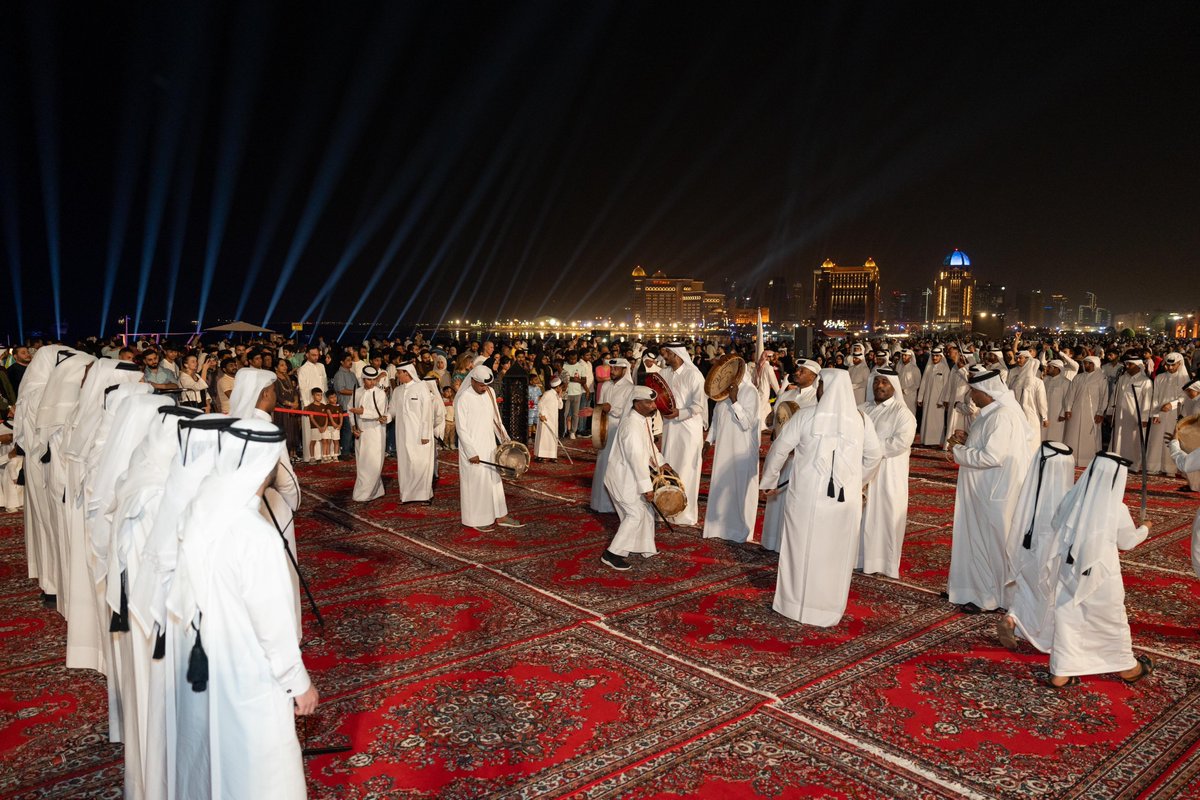
Al Tamimi also noted that men mark Eid through the “Al-Ardah” sword dance, performed after afternoon prayers in public gathering spaces such as central squares and coastal areas, with historical performances also held in various traditional neighbourhoods.