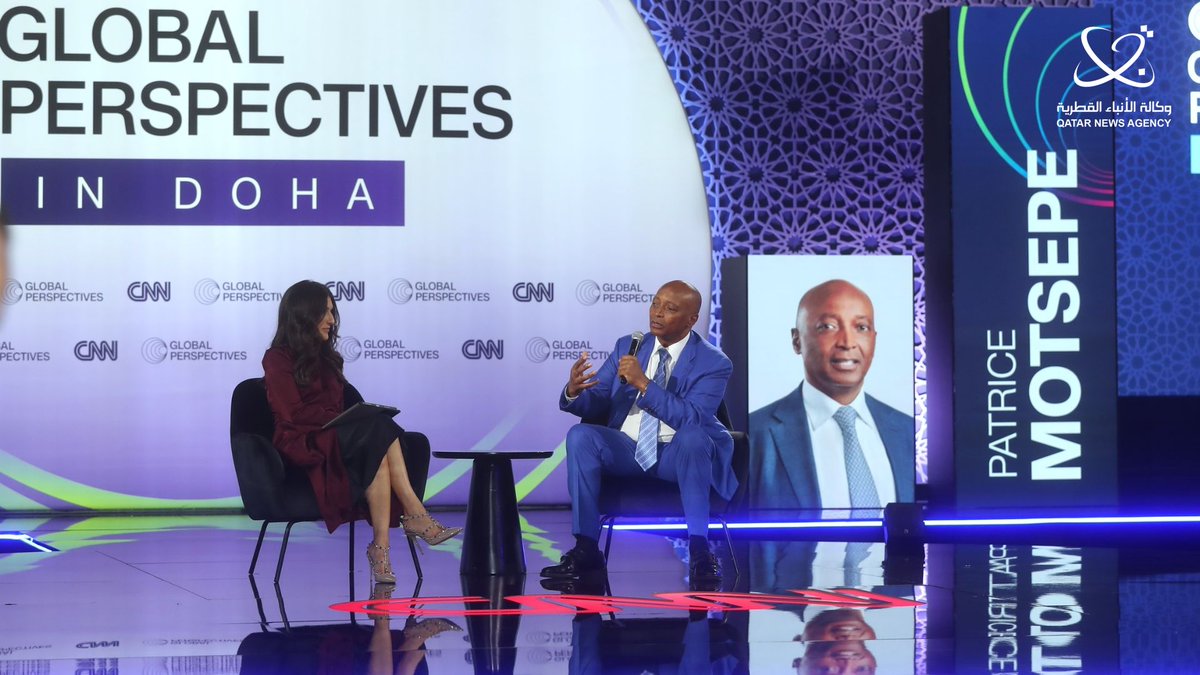
Doha: President of the Confederation of African Football (CAF) Dr. Patrice Motsepe affirmed that football in Africa is undergoing major structural transformations that have enhanced its commercial value and investment appeal internationally.
He indicated that substantial investments in African football would create job opportunities, foster the development of infrastructure, women's football, and youth sports academies, and increase the prize money for African tournaments.
These efforts are already yielding results by maximizing the economic and sporting impact of Africa on the global stage, cultivating talent and stars, and transforming the sport into a platform for education and development.
This came during Motsepe's participation on Thursday in a session as part of the "Global Perspectives: In Doha" event, organized by CNN in collaboration with Media City Qatar.
In response to a question regarding investment and profitability in global football, Motsepe emphasized that any football venture must be sustainable and viable for the future. He pointed to the success of the recent Africa Cup of Nations in Morocco, which was followed by 3.5 billion people across 180 countries and generated 6.2 billion digital views.
He also commended the great success of the FIFA World Cup Qatar 2022, the significant legacy it left behind, the widespread international engagement and viewership it garnered, and the positive impact this has had on the image of football - and sports in general.
Motsepe addressed the massive sums required by the global football industry, saying that the CAF aims to attract a portion of these investments to develop young talent in Africa, alongside the ambition of seeing an African national team crowned world champion.
He affirmed his support for FIFA President Gianni Infantino, highlighting the importance of working collectively with all stakeholders to develop the sport.
Speaking during a panel discussion on governance and ethics in football, the CAF President emphasized that these elements are fundamental pillars for a successful future, both for the Africa and for the world of football as a whole.
Regarding the ongoing discussions and proposals concerning whether the Africa Cup of Nations should be held every four years or remain on its current biennial schedule, Motsepe noted that there is a broad debate among African federations on this matter. He highlighted that he recently announced a study and review of the issue, noting that there is popular support for maintaining the two-year cycle.
He said that the final decision in this regard will be announced soon, in a manner that serves the interests of African football.
The discussion during the session highlighted the economic and commercial dimensions of football, exploring how it has evolved into a massive industry generating billions of dollars. It also addressed major shifts in the sport, such as the expansion of the 2026 World Cup to 48 teams, and the leveraging of the sustainable legacy left by the World Cup held in Qatar.
The discussion also dealt with the tremendous growth and economic rise of African football, the role Africa is set to play in this regard in the future, and the challenges facing FIFA in relation to all of this.