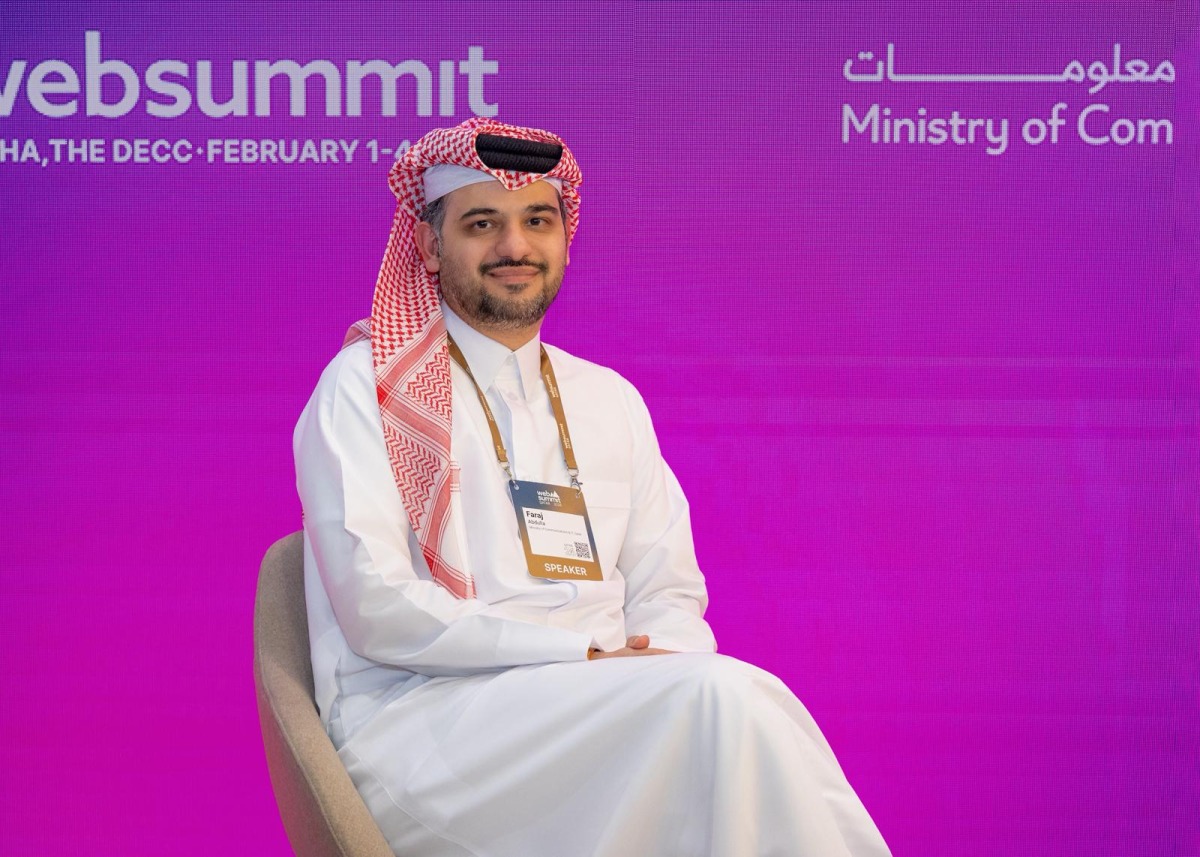
Director of the Digital Economy Department at MCIT, Faraj Al Abdullah
Doha, Qatar: Qatar has built a comprehensive, end-to-end digital innovation ecosystem that supports startups from early incubation through to global expansion, as the country positions technology as a central pillar of its economic diversification strategy, a senior official from the Ministry of Communications and Information Technology (MCIT) said.
In an interview with The Peninsula, Director of the Digital Economy Department at MCIT Faraj Al Abdullah
(pictured), noted that the ministry has designed an integrated framework that enables startups and global technology companies to innovate, test, commercialise, and scale from Qatar to international markets.
“Technology is a central pillar of Qatar’s economic diversification strategy under the Third National Development Strategy and Digital Agenda 2030,” Al Abdullah said on the sidelines of Web Summit Qatar, which concluded yesterday. “The country is targeting a contribution of QR40bn to non-hydrocarbon GDP by 2030, alongside the creation of approximately 26,000 new ICT jobs.”
Al Abdullah explained that MCIT’s approach is anchored around three core programmes, each tailored to a different stage of a company’s growth journey.
He said, “The Digital Incubation Centre provides zero-equity incubation and acceleration and has supported 415 startups that have collectively raised more than QR250m”.
For companies ready to deploy solutions in real-world settings, the TASMU Accelerator connects innovators directly with government entities and national infrastructure.
The programme has attracted participants from 78 countries and generated more than QR670m in sales by enabling startups to test and implement solutions across sectors such as transport, healthcare, and smart cities.
“Scale Now, our scale-up programme, targets companies with proven traction and helps them close deals, raise capital, and expand regionally and globally,” Al Abdullah said.
Since its launch, more than 500 startups have been supported across MCIT’s ecosystem, with Scale Now alone enabling 30 companies across 15 sectors to close QR40m in business deals and raise QR48m in funding.
More than 65 percent of the programme’s portfolio is AI-driven, with top performers recording revenue growth exceeding 50 percent.
Beyond its in-house initiatives, MCIT is also partnering with leading global technology firms to bring world-class capabilities into Qatar.
Al Abdullah highlighted collaborations with PwC and OpenAI, which have resulted in the launch of a national AI sandbox allowing government entities and startups to test solutions in a controlled environment.
Investment into Qatar’s startup ecosystem grew by more than 130 percent in 2024, he noted, underscoring the country’s ambition to serve as a regional gateway for innovation.
He accentuated that AI is already delivering measurable productivity gains across government, citing the AI-powered Building Permit System that reduced approval times from 30 days to about two hours, and the Microsoft Copilot programme, which has saved more than 240,000 working hours.
“Technology acts as a productivity multiplier,” Al Abdullah said, adding that continued investment in AI, smart cities, and digital transformation will support Qatar’s transition toward a resilient, knowledge-based economy.