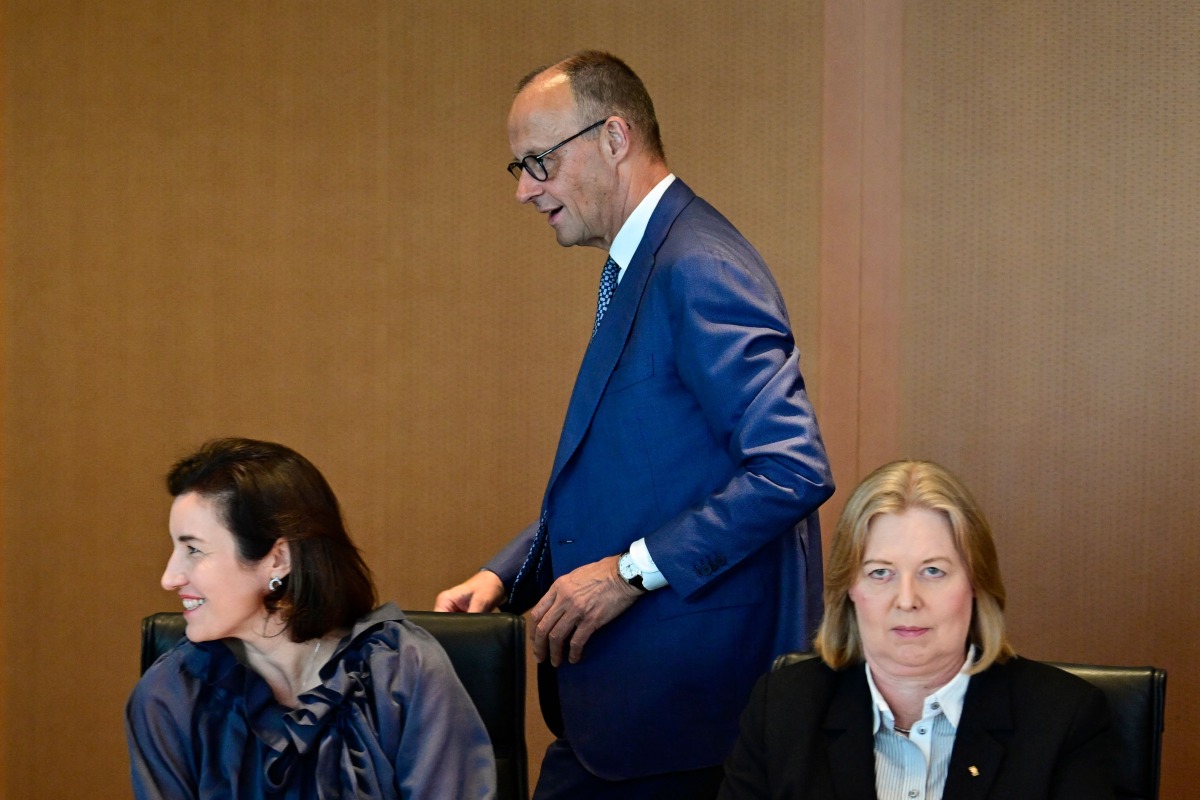
German Chancellor Friedrich Merz walks past German Minister for Research, Technology and Aerospace Dorothee Baer (front L) and German Minister for Labour and Social Affairs Baerbel Bas prior to the weekly cabinet meeting at the Chancellery in Berlin, Germany, on July 6, 2026. (Photo by John MACDOUGALL / AFP)
Berlin: The German cabinet approved the government's 2027 budget proposal today, which includes higher spending and increased new borrowing, amid a wave of sharp criticism.
The draft budget allocates total expenditures of 555.5 billion Euros, up from 525.5 billion Euros in the current year's budget.
Under the main budget, approximately 109.7 billion Euros have been allocated to the Ministry of Defense in 2027, an increase of nearly one-third compared with this year's budget. Defense and security spending remains exempt from the debt brake mechanism up to the equivalent of one percent of gross domestic product.
The proposal also earmarks about 11.6 billion Euros to support Ukraine in its war with Russia. In addition, it authorizes net new borrowing of 118.7 billion Euros, compared with 98 billion Euros planned for the current year.
This borrowing is in addition to new debt generated through special funds dedicated to infrastructure, achieving climate neutrality, and the special fund for the German armed forces.
Total new borrowing next year is expected to exceed 200 billion Euros, with new debt projected to rise to 219.5 billion Euros by 2030.
The government intends to use money from the infrastructure fund for projects including the repair of bridges, roads, and the deteriorating railway network. The federal government also plans to make investments totaling 117.5 billion Euros next year.
The plans has drawn strong criticism from political and economic circles in Germany over the planned sharp increase in new borrowing. Environmental organizations have also accused the governing coalition of depleting the climate fund.