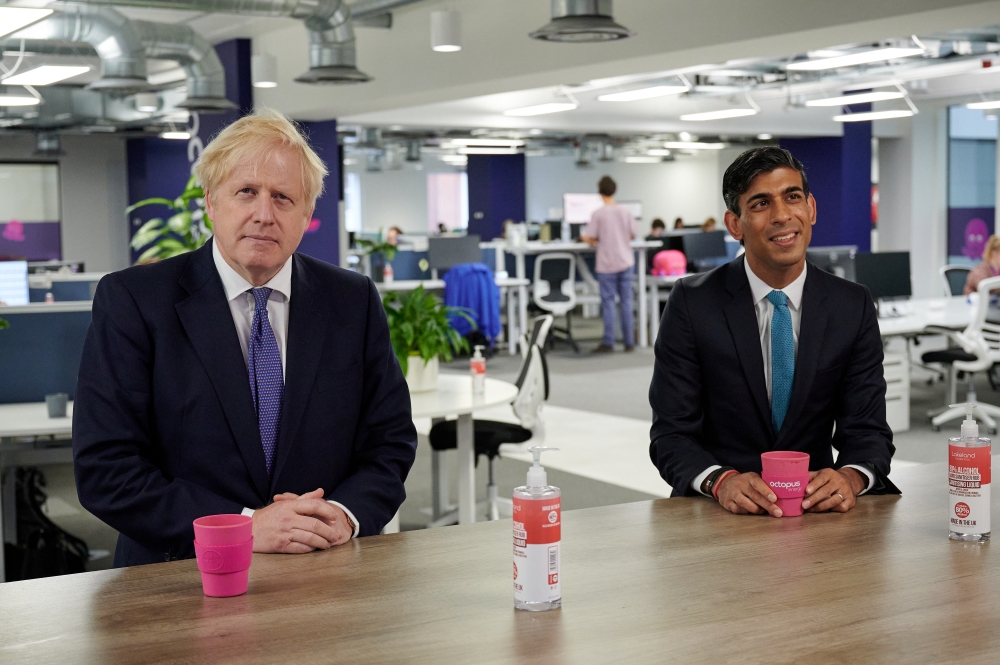
Britain's Prime Minister Boris Johnson and Britain's Chancellor of the Exchequer Rishi Sunak visit the headquarters of Octopus Energy, in London, Britain October 5, 2020. Leon Neal/Pool via Reuters
UK Chancellor of the Exchequer Rishi Sunak rejected the idea that his flagship program to give people discounts on going to restaurants helped spread the coronavirus over the summer.
"I would be, I guess, cautious about jumping to simplistic conclusions,” Sunak said on Sky News on Tuesday. "It’s incredibly difficult to pinpoint at such a granular level exactly the cause of transmission.”
The chancellor was defending a Treasury program that was key to his efforts to protect hospitality jobs.
On Sunday, Prime Minister Boris Johnson told the BBC’s Andrew Marr program that the initiative -- which paid people up to 10 pounds ($13) per person for a meal in a restaurant in a bid to boost the hospitality sector -- might have helped the transmission of the disease.
"In so far as that scheme may have helped to spread the virus obviously we need to counteract that and we need to counteract that with the discipline and the measures that we’re proposing,” Johnson said.
But Sunak did not see a cause-and-effect relationship. He added that the incidence of the virus has been lower in areas like the southwest of England, where there was significant take-up of the offer.
The government is now trying to suppress a resurgence of the virus as the country heads into the winter months, including by imposing new restrictions on hospitality.
Sunak told BBC TV on Monday that a 10 p.m. curfew on pubs and restaurants "could” help slow transmission, a half-hearted endorsement of a policy that’s sparked the ire of rank-and-file Conservative Members of Parliament.
In his series of morning interviews, Sunak also: