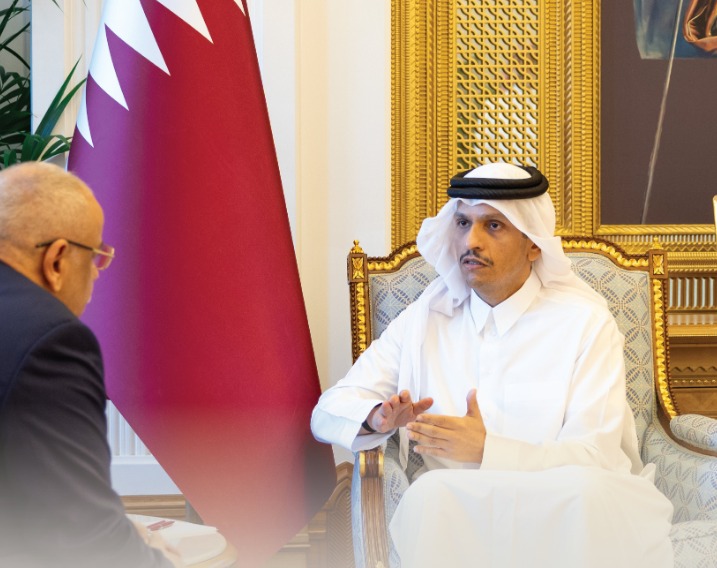
Doha, Qatar: Prime Minister and Minister of Foreign Affairs HE Sheikh Mohammed bin Abdulrahman bin Jassim Al Thani affirmed that Qatar, in coordination with Gulf countries, is prioritizing diplomatic efforts aimed at ending the regional crisis and reopening the Strait of Hormuz.
In an interview with Al-Araby Aljadeed newspaper, published on Thursday by MoFA, the Prime Minister said: “The State of Qatar, in coordination with its brothers in the Gulf countries, is striving to provide space for diplomacy in order to reach a resolution that puts an end to this crisis and reopens the Strait of Hormuz, as this remains our priority.”
He expressed hope for a comprehensive understanding between the United States and Iran, stating: “We aspire to an agreement between Washington and Tehran that establishes permanent solutions to all outstanding issues between them and takes into account the interests of the region’s countries and the entire world.”
Addressing prospects for diplomacy despite ongoing tensions, he said: “Despite the divergence in positions between Tehran and Washington, there exists a high potential for reaching a diplomatic resolution. Certainly, this remains contingent upon the conditions that evolve on a daily basis.”
“The ongoing tension in the Strait of Hormuz compels us to exercise caution in our judgments and expectations. However, in all circumstances, we remain hopeful for a detente and collaborate with others to achieve this.”
The Prime Minister stressed the global implications of disruptions in the strategic waterway, saying: “The entire world is bearing the cost of the closure of the Strait of Hormuz. From the very first day of the crisis, we declared it unequivocally: we reject the use of this passage as a pressure tool in any conflict, whether political or military.”
“We have conveyed it candidly to all parties: the closure of the strait will not resolve anything; rather, it will exacerbate the crisis and expose the interests of the countries in the region to severe risks,” he added.
Reaffirming Qatar’s long-standing position against escalation, he said: “Our position before the outbreak of the war was clear, and we declared it openly to all: we oppose any escalation and support dialogue as the sole path to resolving differences.”
Referring to attacks targeting Qatar, the Prime Minister stated: “When the unjustified attacks were carried out against us, despite being a sovereign state not party to the war, we declared our explicit condemnation and our right to self-defense in accordance with international law. Our sovereignty is a red line that will never be compromised.”
He also condemned attacks on civilian infrastructure, saying: “Qatar condemns any attack on civilian facilities, regardless of its source. These facilities are not targets; they are a source of livelihood for our peoples, the backbone of our economies, and an integral part of global energy security.”
Highlighting regional unity, Sheikh Mohammed said: “The recent developments in the region, and the unprecedented challenges they have produced, have confirmed an indisputable reality: the security of the Gulf Cooperation Council states is indivisible.”
On relations with Washington, he added: “We reaffirm the depth of our strategic relations with the United States. These relations are founded on a comprehensive partnership, shared interests, and solid understandings.”
“I state it unequivocally: The security of the region and the freedom of navigation are red lines that are non-negotiable in any discussions, regardless of the parties involved.”
The Prime Minister also underlined Qatar’s economic resilience amid regional developments, saying: “Qatar has undergone numerous challenging phases, the most recent being the COVID-19 pandemic, and on every occasion, our economy has demonstrated its resilience and ability to absorb shocks and address them.”
“We have clear plans, flexible strategies, and financial reserves sufficient for extended periods. This enables us to continue implementing our major projects and the Qatar National Vision 2030 without the citizens or residents being affected by the repercussions of the current crisis.”
On economic policy, he said: “In the upcoming phase, we will witness measures aimed at enhancing and rationalizing public expenditure efficiency, alongside a package of policies to empower the private sector and support economic growth. We will also accelerate the implementation of the economic diversification strategy. This is a steadfast national choice for us, and there will be no retreat from it.”
Regarding Gaza ceasefire efforts, the Prime Minister said: “We are working in Qatar, in coordination with our partners, to ensure the implementation of President Trump's plan for a ceasefire in Gaza. Our objective is to consolidate the truce and improve humanitarian conditions in the Strip.”