By Satish Kanady
DOHA: If the energy prices are to remain lower for longer, Qatar would probably envisage stepping up bond issuance, perhaps with a view to attract international investors, according to a new report.
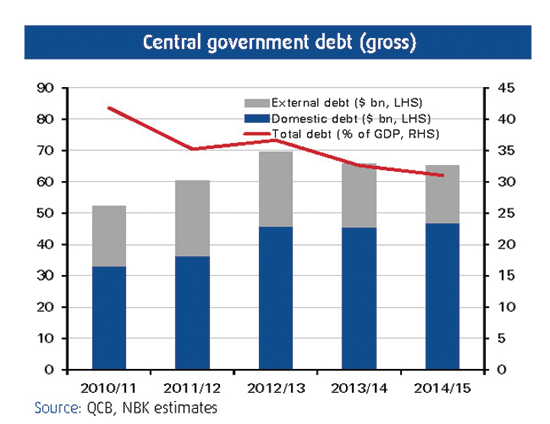
NBK’s updated economic outlook for Qatar noted the country’s gross government debt had dropped to 31.0 percent of GDP in 2014 from a high of 42.0 percent in 2010 after the authorities paid back maturing public debt.
The report, however, noted this trend could reverse. For instance, banking sector which has started beginning to feel the effects of low oil prices credit growth has been moderating over the last year owing to a slowdown and contraction in public sector borrowing. The most recent data showed overall bank credit growing by 12.0 percent year-on-year in September, with credit to the public sector contracting by -6.6 percent year-on-year.
In contrast, credit growth to the private sector has averaged 22.0 percent year-on-year for most of the year (compared to 15.6 percent in 2014), as banks continue expanding credit lines to the real estate, industrial and retail sectors.
In view of the government’s commitment to continue spending on infrastructure and expand private sector participation in the development plan, the outlook for credit growth remains positive. Lower deposit flows raise funding and liquidity pressures. Reduced government deposits in the banking system resulting from lower oil and gas prices have slowed overall deposit growth considerably over the previous year.
The NBK report noted the trajectory of energy prices is the central to Qatar’s economic outlook. With its sizeable fiscal buffers and AA credit rating, Qatar remains well positioned to weather the current period of low energy prices. Nevertheless, the longer oil and gas prices remain depressed, the more pressure Qatar will face on its finances and banking sector.
In a sign of rising pressures, along with a rise in the forward currency curve, the 5-year sovereign credit default swap spread widened significantly, by 14 bps, during the second half of the year. The likely arrival in 2016 of Australia and the US as LNG exporters is another concern. Qatar’s low gas production cost base, however, should enable it to compete effectively in this new environment. The trajectory of energy prices is the central to risk to the outlook. With its sizeable fiscal buffers and AA credit rating, Qatar remains well positioned to weather the current period of low energy prices.
Qatar’s fiscal balance is likely to swing into deficit in 2016, for the first time since 1999. With spending levels remaining relatively elevated amid a 40 percent decline in hydrocarbon revenues, the fiscal surplus is forecast to narrow from 16.1 percent of GDP in 2014 to -0.5 percent of GDP in 2016.
Similarly, the current account surplus is likely to narrow considerably. On the fiscal side, future spending is likely to be rationalized. While current spending will be restrained, capital spending will need to rise as the authorities make up for previous below -budget outlays, due to delays and capacity constraints, and push ahead with implementing their development plan ahead of the World Cup in 2022.
The prospect of a sustained period of low energy prices has prompted the government to proceed with reforming the state’s finances. New measures include the introduction of a QR600bn($165bn) spending cap on new investment projects for 10 years; the creation of a macro-fiscal unit and public investment management department(PIM); the withdrawal of subsidies to certain state institutions; and the privatization of semi-government institutions. With $39.6 bn in international reserves, excluding the $256bn sovereign wealth fund (SWF) and strong credit ratings, however, Qatar has sufficient assets to finance capital spending and weather the fall in energy prices, NBK analysts noted.
The Peninsula