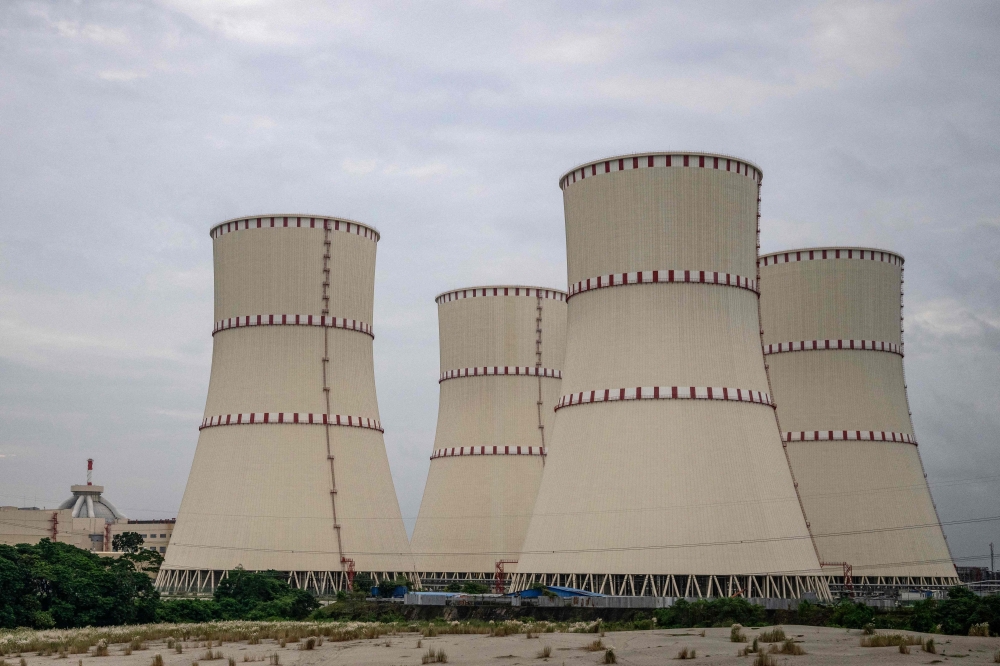
This photograph taken on September 24, 2026 shows a general view of the Rooppur Nuclear Power Plant at Ishwardi in Bangladesh's Pabna district. (Photo by Salahuddin Ahmed / AFP)
Dhaka: Bangladesh has approved a 442-megawatt solar plant on land originally earmarked for a coal-fired power station, as it seeks to boost its renewable energy sources, officials said Thursday.
The $230-million Rampal project, which would be the country's largest solar facility, is expected to be operational by 2029 after winning government approval on Wednesday.
The project comes as Bangladesh grapples with an energy crisis and heavy dependence on imported fuels, while renewable power accounts for only a small share of its installed capacity.
Bangladesh relies heavily on imported energy, including liquefied natural gas (LNG), and has been hit by fuel-supply disruptions linked to the conflict in the Middle East.
The country of 170 million people suffers from chronic electricity shortages.
Bangladesh has about 1.87 gigawatts of installed renewable energy capacity, roughly 6.5 percent of its 28.9-gigawatt grid-connected capacity, according to government data.
Zonayed Abdur Rahim Saki, a minister at the Ministry of Planning, said the land had initially been acquired for the expansion of an existing coal-fired power plant.
"The government dropped the second phase of that coal power plant, and replaced it with a solar power project as part of its promise to increase the renewable energy generation capacity and reduce carbon emission," he said, speaking to reporters after the plant was approved.
The Rampal site lies roughly 14 kilometres (nine miles) from the edge of the Sundarbans, the world's largest mangrove forest.
Bangladesh's power system remains dominated by fossil fuels, with gas accounting for about 43 percent of installed capacity, followed by oil and coal, making up nearly the same percentage.
It also depends on electricity imported from neighbouring India and Nepal.
Nepal was hit hard by catastrophic Himalayan floods in August, which badly damaged a string of hydropower facilities.
Bangladesh's first nuclear power plant, the 2.4-gigawatt Rooppur facility, is due to begin operations by the end of 2026 after more than a decade of construction.
Dhaka has set a target of generating 20 percent of its electricity from renewable sources by 2030.
Prime Minister Tarique Rahman has installed a solar rooftop system at his home as part of government efforts to promote wider adoption, including financial incentives.
Bangladesh's key garment industry is also fitting solar systems, said Mohammad Hatem, president of the Bangladesh Knitwear Manufacturers and Exporters Association.
Hatem has installed a six-megawatt solar system on the roof of his factory in Narayanganj, outside Dhaka.
"Many of our members are showing interest in rooftop solar," he said.