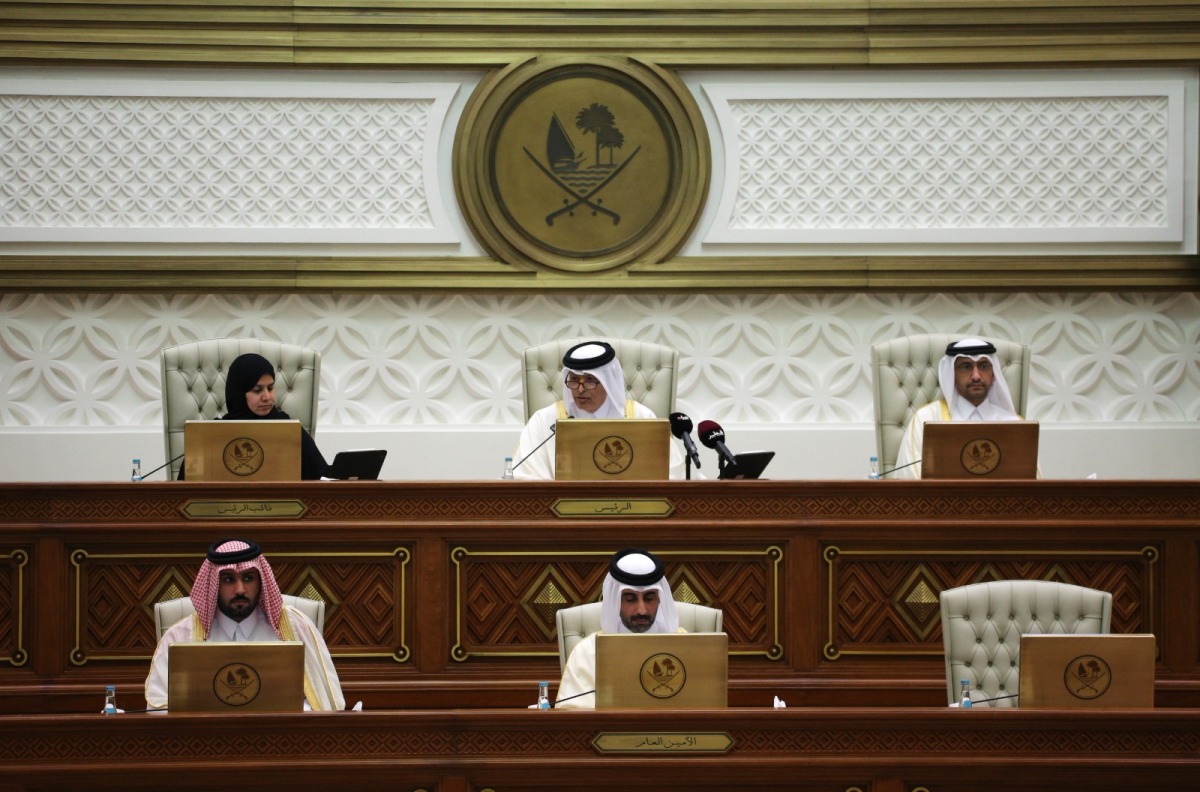
Speaker H E Hassan bin Abdullah Al Ghanim and Minister of Justice H E Ibrahim bin Ali bin Issa Al Hassan Al Mohannadi at Shura Council’s regular weekly session.
Doha, Qatar: Minister of Justice H E Ibrahim bin Ali bin Issa Al Hassan Al Mohannadi has affirmed that the Ministry is pressing ahead with its projects under the 2025-2030 strategic plan, guided by a comprehensive vision focused on full automation of services and strengthened electronic integration with government entities.
He said that the approach aims to streamline procedures, enhance institutional performance, and deliver more efficient and accessible services to the public.
The Minister was speaking at the Shura Council’s regular weekly session held yesterday in Tamim bin Hamad Hall at the Council’s headquarters, chaired by the Speaker H E Hassan bin Abdullah Al Ghanim.
The Speaker extended, in his own name and on behalf of Their Excellencies the Council members, greetings to Amir H H Sheikh Tamim bin Hamad Al-Thani on the occasion of the approaching Holy month of Ramadan, extending his warmest greetings and best wishes on this blessed occasion to His Highness, the people of Qatar, and all residents of Qatar.
He wished them health, happiness, and prosperity, and hoping this month brings peace, security, and well-being to the Arab and Muslim communities.
Thereafter, Secretary-General of the Shura Council H E Nayef bin Mohammed Al Mahmoud read out the agenda, with the council endorsing the minutes of the previous meeting.
Upon invitation from the Speaker, the session was attended by Minister of Justice, alongside various specialists from the ministry to present the ministry’s efforts and its strategic plan, in addition to debating a raft of matters related to their operations in a variety of sectors. Al Mohannadi presented a comprehensive overview of the key features of the Ministry of Justice Strategic Plan 2025-2030, encompassing the achievements of various legal and service sectors at the ministry, including projects associated with automating agreements and international cooperation services, lawyers, experts, and arbitration.
This likewise includes developing the Qatar Legal Portal (Al-Meezan), the Official Gazette, and the Legal Journal, the Real Estate Registration and Disposal System development project, the Real Estate Platform, and the Smart Legal Assistant Project (Shor) to enhance the efficiency of legal cadres. Al Mohannadi noted the Ministry’s contribution to stimulating the business environment by reducing the fees for a large number of services it provides for the first time, while expanding the scope of exemptions.
He highlighted the issuance of Decision No. (70) of 2025 regarding the Executive Regulations of Law No. (5) of 2024 regulating Real Estate Registration, the executive decisions of the law, and the amendments contained in Law No. (19) of 2025 amending certain provisions of the Attorney Law issued under Law No. (23) of 2006, which will help create new job opportunities for law firms.
He pointed out that the Ministry reviewed 1,576 government contracts between January and September 2025, as well as 1,200 agreements and memoranda during 2025, in addition to preparing 12 model contracts as references. This is alongside the recommendations issued by the Doha Legal Forum in the field of digital transformation and the legal regulation of modern technologies.
Regarding the development of real-estate documentation and registration procedures and services, Al Mohannadi noted the launch of the video-communication service for the first time, and the completion of 114,339 documentation transactions, of which 2,235 were electronic, and 43,680 real-estate registration transactions, of which 1,257 were electronic during 2025.
This in addition to documenting company registration transactions electronically and linking services with the Qatar Digital ID (QDI) system, which will help clients accomplish their transactions online without the need to visit the ministry or its external service offices, along with the registration of 800 real-estate brokers, updating the mapping program, and designing interactive boards for monitoring real-estate market movement, the minister pointed out.
The Minister further referred to the issuance of several decisions regulating Electronic Real Estate Registration and the Preliminary Property Registry, which organizes and defines the off-plan sales procedures, noting that this will contribute to the stability of investment operations in real estate development projects sold under construction and enhance their investment attractiveness.
In response to the observations of the members, the Minister of Justice affirmed that the Ministry is advancing its projects within the framework of the strategic plan (2025-2030), following a methodology centered on full automation of services and enhancing electronic integration with government entities, contributing to streamlined procedures and elevated performance efficiency.