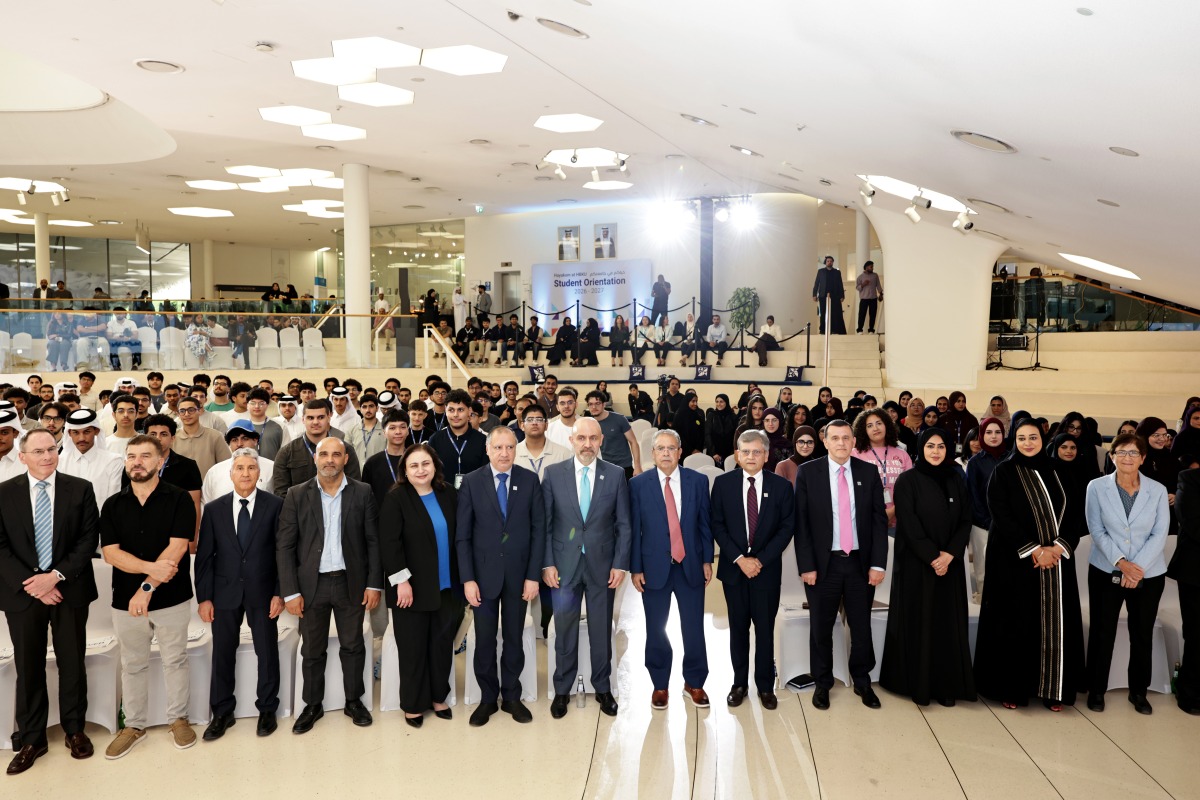
Staff and new students during HBKU’s Hayakom Student Orientation 2026-2027 held at the Minaretein in Education City. PIC: SALIM MATRAMKOT/THE PENINSULA
Doha, Qatar: Hamad Bin Khalifa University (HBKU), a member of Qatar Foundation, welcomed its newest cohort of students at the Hayakom Student Orientation 2026–2027 yesterday, marking the beginning of their academic journey at a research intensive, multidisciplinary university focused on education, innovation and real world impact.
The homegrown research university proudly carries the name of late Father Amir H H Sheikh Hamad bin Khalifa Al Thani, whose vision recognised education, research and innovation as foundations of Qatar’s progress.
Vice President for Student Affairs Dr. Maryam Hamad Al-Mannai said students have the “privilege and responsibility” to carry forward that vision through “knowledge, curiosity, integrity and commitment to serving society.”
This year’s incoming cohort comprises 891 students, including 315 undergraduates and 576 graduate students, with 318 Qataris.
They represent 79 nationalities and join an academic community with 2,780 alumni and 40 GCC students. The students were selected from a talented applicant pool from across the Arab world and beyond, meeting HBKU’s rigorous admissions standards.
They will join an ecosystem where education, research and innovation intersect, with the university’s programmes designed to address emerging needs in Qatar’s public and private sectors.
HBKU offers 51 academic programmes across eight colleges and schools, including 17 programmes at the College of Science and Engineering, 11 at the College of Islamic Studies, seven at the College of Health and Life Sciences and five at the College of Humanities and Social Sciences.
It also offers programmes through the College of Law, College of Public Policy, School of Economics and Management and School of Education.
Held at the Minaretein in Education City, yesterday’s orientation activities focused on undergraduate students, while the orientation for graduate students will be held on Thursday.
Addressing students yesterday, Provost Prabhat Hajela described HBKU as “a very distinctive university” that is deeply rooted in Qatar while maintaining a global reach. “As you join us, you become part of a university that thrives on intellectual curiosity, purposeful discovery and a shared commitment to making an impact,” he told students.
Hajela encouraged students to embrace interdisciplinary learning, noting that challenges in fields including energy, sustainability, artificial intelligence, health and infrastructure rarely fit within a single discipline. “Learning to collaborate, think creatively and connect ideas across fields will be an important part of your education,” he said, urging students to use opportunities to work with people and institutions addressing real-world challenges.
Spokesperson for Student Affairs Rashid Adiba said the orientation was designed to introduce students to HBKU’s academic and student-support ecosystem, including its facilities, programmes and a resource fair showcasing ser vices available to students.
Speaking to The Peninsula he said that HBKU’s programmes are developed to con tribute to Qatar’s employment and innovation systems, while its alumni continue to serve as ambassadors for the university.
More than 2,700 graduates have completed their studies and are contributing to the labour market in Qatar and internationally.
At the College of Public Policy, Dr Logan Cochrane said demand for the college’s programmes remains strong. Its offerings include master’s degrees in Public Policy, Social Policy and Programme Evaluation, and Global Health Policy, alongside a new one-year Public Policy certificate taught in Arabic.
“Our focus is on the quality of education, ensuring that we give our students the skills and knowledge they need to become leaders in the future,” Cochrane said.
He added that evening classes enable working professionals to pursue graduate edu cation while continuing their careers, supporting Qatar’s national development goals by building capabilities within the public sector and other key fields.