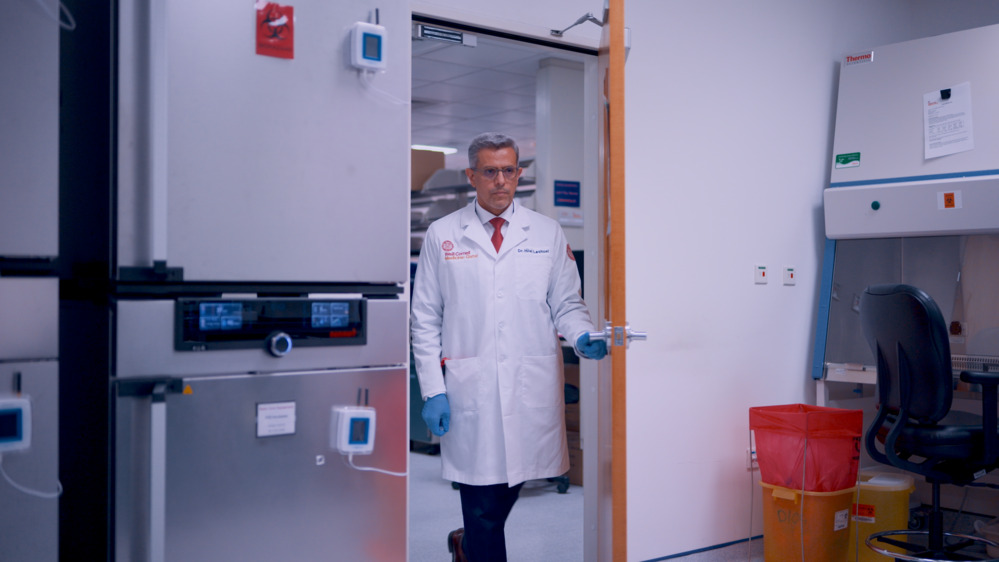
Globally recognized Qatar Foundation researcher Dr. Hilal A. Lashuel discusses the Parkinson’s challenge facing the world, the unanswered questions behind the research he is spearheading, and Qatar’s role in advancing biomedical discovery
Doha, Qatar: Backed by a USD 9 million, three-year global research grant, an international team led by Dr. Hilal A. Lashuel, professor of neuroscience in neurology at Qatar Foundation partner university Weill Cornell Medicine-Qatar, is seeking to push the frontiers of global understanding of Parkinson’s disease – and help to develop new treatments for it.
Following the award of the grant from Aligning Science Across Parkinson’s (ASAP), in partnership with The Michael J. Fox Foundation for Parkinson’s Research, Dr. Lashuel - who is also research development and innovation advisor to the chairperson of Qatar Foundation, executive director of RDI within the Qatar Foundation Chairperson’s Office, and professor emeritus at the Swiss Federal Technology Institute (EPFL) – explains why this project is so vital to the global search for a cure for Parkinson’s disease, and what it means for Qatar’s international status as a hub of science and research.
How much do we currently know about Parkinson’s disease globally, and how much remains unknown?
We have made significant progress in advancing our understanding of Parkinson’s disease over the past three decades, but many key questions remain unanswered. We still don't fully understand what truly triggers the disease in most people, why it shows different symptoms and disease progression patterns from one patient to another, and –most importantly – how to stop or reverse the disease.
Today, at least 10 to 12 million people worldwide live with Parkinson’s disease, and it is the fastest-growing neurological condition on the planet. This alarming trend underscores the need for a better understanding of the disease and the development of more effective therapies to prevent or slow disease progression, especially as the number of affected individuals is projected to rise to 25 million by 2050.
The encouraging news is that today we have access to new knowledge, tools and technologies that did not exist before. Thanks to new advancements in the development of human and disease relevant cellular model systems – such as those we developed in our lab –combined with new advances in genetics, genetic engineering, imaging and biological analysis tools, we are able to investigate the underlying mechanisms of the disease with unprecedented precision.
For the first time, I feel the pace of scientific discovery is starting to keep up with the magnitude of the challenge posed by this disease.
Can Parkinson’s be prevented, or are we still far from a clear prevention strategy?
Today, we do not know how to prevent Parkinson’s disease, but there are encouraging signs that some risk factors can be modified. Growing evidence suggests that regular physical activity, a healthy diet, good sleep, social engagement, and managing cardiovascular risk factors may all help support long-term brain health and potentially reduce the risk of developing the disease.
Perhaps the most important lesson from other areas of medicine is that prevention often becomes possible only after we understand a disease well enough to detect it early, monitor how it progresses, and identify the factors that drive it. Decades ago, we knew little about the causes of heart disease; today, the availability of early diagnostic tools, effective cholesterol lowering drugs, disease monitoring tools, and prevention have saved millions of lives.
I am optimistic that as our understanding of Parkinson’s is following the same course.
Why is this work being led from Qatar?
My research team has been studying Parkinson's disease for more than 20 years. Over this time, we have developed unique foundational knowledge, tools, technologies and cellular models that allow us to investigate the mechanisms underpinning Parkinson's in ways that were not previously possible.
These advances form the foundation of the ASAP Project, but its plans, direction and ambition are equally shaped by the expertise and technologies of our partnering groups at Stanford University and Arvinas. Together, the team brings complementary strengths spanning different disciplines, including stem cell biology, cellular reprogramming, lysosomal biology, functional genomics, genetic screening, and targeted protein degradation.
While leadership from Doha reflects the origin of the core science, the project also builds on major advances made by all the partners who will play leadership roles in shaping the project's direction, priorities, and translational ambitions, from discovery through to therapeutic development.
What is the impact you hope this research project will lead to?
By uncovering how toxic protein aggregates form, spread, and damage brain cells, and why the brain fails to remove them, we hope to identify new therapeutic targets and strategies to prevent the formation of protein aggregates, neutralize their toxic properties, and promote their removal.
Just as importantly, we aim to develop better models that can recapitulate the complexity of the disease pathology in the lab and tools that can help the broader scientific community accelerate the discovery and testing of new treatments.
Ultimately, I want our models to become a launchpad for discovering treatments that slow, stop, or even prevent Parkinson’s.
Many people will see this as a Parkinson's story. Why is it also a Qatar story?
Parkinson's disease is a global human story. The disease knows no borders: it affects individuals and their families in Qatar, across the region, and around the world. Confronting it demands global collaboration and the best minds and resources we can bring together. The challenges we face as researchers working to find cures for this devastating disease are not only technological ones that require significant resources, but also conceptual ones that require new ideas, new ways of framing the problem, and creative solutions. That is precisely why every country and every scientist around the globe has a role to play in tackling Parkinson's.
But it is also a Qatar story. We want Qatar to be an active and meaningful contributor to the global effort to improve the quality of life of those affected and their families, and ultimately to find a cure. This work, and the international funding we are receiving, is a true testament to the world-class science being done here and global recognition of Qatar's long-term investments in building world-class scientific structure and capabilities and its growing role as an important contributor to global research.
Are there certain regions, populations or communities where Parkinson’s is more common, and if so, do we know why?
Yes, Parkinson’s disease is more common in some populations than others. Age is the biggest risk factor, so countries with older populations tend to have higher rates. Certain genetic variants are also more common in specific communities and can increase the risk of developing the disease.
However, much of what we know comes from studies in Europe and North America. We still have limited data from many parts of the world, including our region. Studying more diverse populations will be essential to better understand the disease and develop treatments that work for everyone. This is one of the key goals of our Parkinson’s research program at Weill Cornell Medicine-Qatar, which we are advancing in close collaboration with other research institutions across Qatar and Qatar Foundation.
How does this project reflect the shift from building research capacity toward producing translational biomedical research with global relevance?
For years, Qatar focused on building the foundations: the institutions, laboratories, and talent. That phase was essential, but it was always a means to an end. This project signals a new phase: the seeds that were planted are now bearing fruit.
This project represents an important transition in Qatar’s journey where the country is starting to bear the fruits of years of investment. We are no longer only building capacity; we are leveraging it to produce discoveries that compete at the global frontier and will have real translational potential. That is the essence of the shift: from acquiring knowledge and tools to generating knowledge, from preparing to compete to actually competing, and winning, on the world stage.
How have Qatar Foundation and Weill Cornell Medicine–Qatar enabled this type of internationally competitive research, and what does this grant say about the maturity of Qatar's research ecosystem today?
The sustained investment by Qatar Foundation and Weill Cornell Medicine-Qatar over the past decades have built mature research and innovation ecosystems that provides researchers with all the infrastructure and resources they need to establish and run globally competitive research programs, including access to state-of-the art facilities and technology platforms, pipelines of talented researchers, a collaborative and interdisciplinary culture, and efficient and supportive research administration teams. All of these factors were central to our ability to compete for and secure competitive global funding of this scale, and pursue high-risk, high-reward projects.
What unique role can Qatar play in supporting global biomedical research?
Qatar has a unique opportunity to contribute to global biomedical research in three important ways.
First, by ensuring that the genetics, lifestyles, and health needs of our region are represented in the scientific evidence that guides the future of medicine. This helps make research more inclusive and relevant to populations that have historically been underrepresented.
Second, by helping to generate new knowledge and discoveries. With the infrastructure, talent, and ambition we have built, Qatar is positioned today not only to participate in global science, but to help shape its direction.
Third, we can do what Qatar does best: lead by example. By acting as a catalyst for change and building bridges for collaboration across the region, we become stronger and more competitive together than apart. The development and maintenance of advanced scientific infrastructures is beyond the financial and human resources and capabilities of any single nation in the region.
This is why we need shared investments and mobility programs to promote scientific mobility and exchange in the region. A stronger, more connected region will be better positioned to contribute to – and compete in – the global scientific landscape.
What message does this grant send to young scientists and students in Qatar who want to pursue neuroscience, medicine or biomedical research?
My message is simple: this grant is proof that the world believes in our ideas, our talent, and our capabilities. You can lead from Doha. You can do frontier research that is on par with the best institutions in the world, without having to leave the region, although I would still encourage you all to pursue international experiences.
Today, Qatar has the infrastructure, resources, and scientific environment needed to tackle some of the most important challenges in medicine and science and therefore, there is nothing to stop you from doing the best science and pursuing big ideas and ambitious projects.
Believe in yourself, work hard, pursue bold questions and collaboration, and you can make global impact from here – and, one day, the next big discovery could carry your name.