
Doha, Qatar: On June 16, 2026, the Bank of Japan (BoJ) raised its benchmark policy rate by 25 basis points to 1%, marking the highest level of interest rates since 1995. The decision represents a significant step in Japan’s gradual exit from the ultra-loose monetary policies that characterized much of the past three decades.
The move follows a normalization process that began in early 2024, when the BoJ ended its negative interest rate policy and initiated a series of rate increases. Attention is now shifting to the question of how much further the normalization cycle can proceed, QNB said in its economic commentary.
The tightening cycle reflects a fundamental shift in Japan’s inflation dynamics. For much of the past decade, the BoJ struggled to achieve its 2% inflation target despite maintaining highly accommodative monetary conditions. However, a combination of post Covid-pandemic supply shocks, stronger wage growth, and rising inflation expectations has led to a sustained increase in underlying price pressures. As a result, policymakers have become increasingly confident that inflation can be maintained around target, reducing the need for extraordinary monetary accommodation.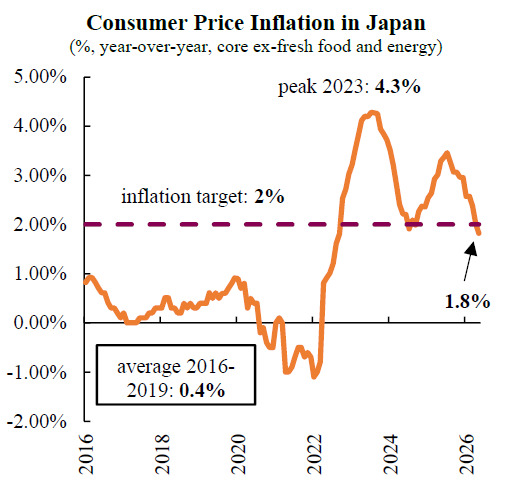 In this article, we discuss three factors that are likely to shape the future path of monetary policy in Japan: the shift away from the country’s long-standing low-inflation environment, the impact of external shocks and exchange rate dynamics on inflation, and the extent to which policy rates may still need to rise to reach a neutral level.
First, Japan’s transition to a more persistent inflation regime supports the case for further policy normalization. For much of the past decade, inflation remained persistently below the BoJ’s 2% target, reflecting weak domestic demand, subdued wage growth, and entrenched low-inflation expectations. More recently, however, inflation has become both higher and more persistent. Core inflation remained above target for an extended period, while households and firms have increasingly adjusted their expectations to a higher inflation environment. In particular, medium- to long-term inflation expectations have risen to around 1.5-2.0%, their highest sustained levels in decades.
Importantly, inflationary pressures are no longer driven solely by temporary supply-side factors. Annual wage settlements have exceeded 5% in both 2025 and 2026, marking the strongest wage growth in more than three decades. Supported by a tight labour market and robust corporate profitability, higher wages strengthen domestic demand. At the same time, firms have become more willing and able to pass rising costs onto consumers, reinforcing underlying price pressures.
Second, external shocks and exchange rate dynamics pose upside risks to inflation. Japan remains heavily dependent on imported energy and raw materials, leaving it vulnerable to fluctuations in global commodity prices and disruptions to international trade. In recent months, the conflict in the Middle East has increased uncertainty in energy markets, raising concerns about the inflationary impact of higher oil prices. Reflecting these developments, the BoJ sharply revised its 2026 core inflation forecast to 2.5-3.0% at its April meeting, up from 1.9% previously, while noting that the pass-through from rising crude oil prices was progressing at a relatively fast pace.
The exchange rate represents an additional source of inflationary pressure. The yen has remained weak by historical standards, increasing the local cost of imported goods, particularly energy and food.
Third, despite the recent tightening cycle, monetary policy may still remain accommodative. The BoJ estimates Japan’s neutral interest rate—the level consistent with stable inflation and economic growth—to be between 1.1% and 2.5%. With the policy rate currently at 1%, borrowing costs may still be below the level required to fully normalize monetary conditions.
Taken together, these developments suggest that the BoJ is likely to maintain its policy normalization process in the coming quarters. Inflation has become more persistent, inflation expectations have shifted higher, and policymakers continue to face upside risks from external shocks and exchange rate dynamics. At the same time, policy rates remain at the lower end of estimates for the neutral rate, suggesting that monetary conditions may still be accommodative. The balance of risks appears tilted toward further tightening, with financial markets and analysts expecting the policy rate to gradually rise toward 1.5% over the medium term.