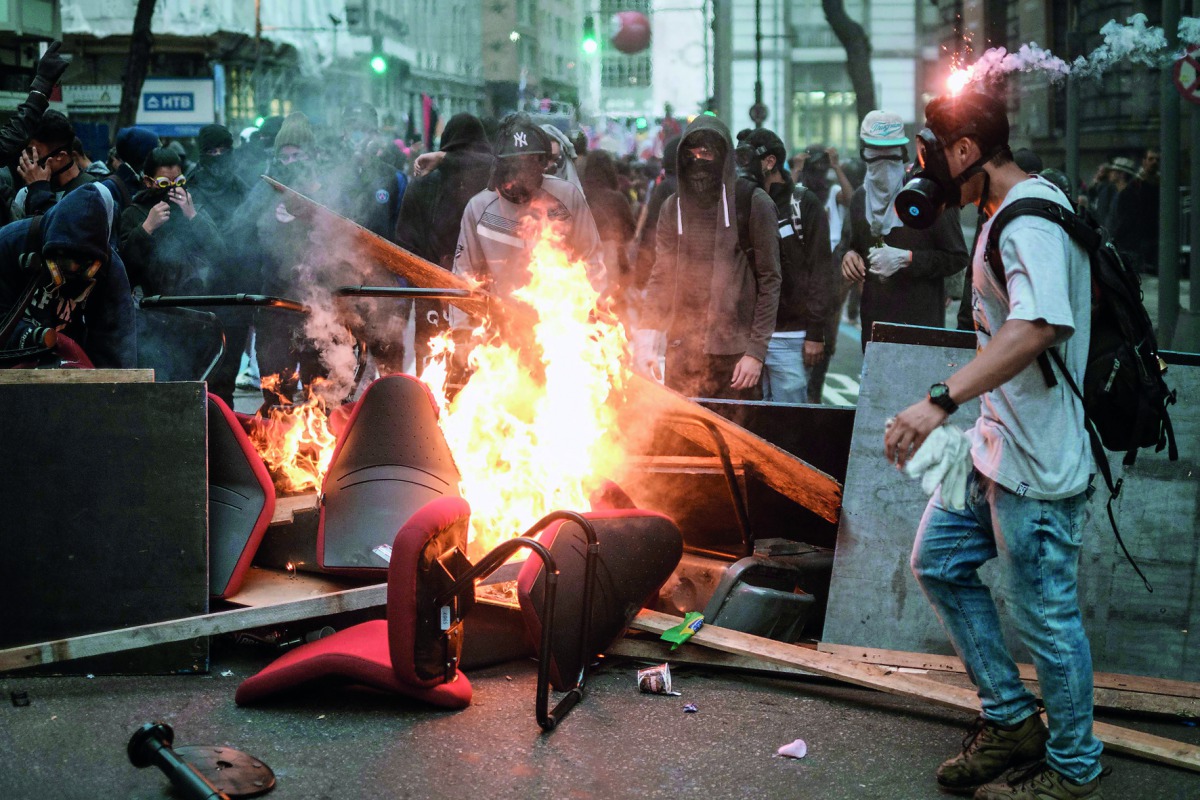
Protesters burn items looted from offices during the nationwide strike called by unions opposing austerity reforms in Rio de Janeiro
Rio de Janeiro: Police in Brazil tear-gassed demonstrators and rioters burned buses yesterday in the violent conclusion of a general strike that shut down transport, schools and banks in protest against austerity reforms.
A peaceful protest by several thousand people in central Rio in the afternoon turned violent, with small groups smashing bank windows, erecting barricades and setting fires, including torching at least eight buses.
Police responded with barrages of rubber bullets and tear gas, which floated through the avenues and up into the high windows of office buildings.
There were similar disturbances in Sao Paulo, the country’s economic powerhouse. A crowd attempted to march to private residence of President Michel Temer and clashed with police, who fired rubber bullets and stun grenades.
As they retreated, the protesters hurled rocks, set fires, smashed street lamps and threw concrete blocks into the centre of the avenue.
The ugly scenes came at the close of a day in which unions and leftwing groups managed to paralyse much of Brazil in protest at the reforms, especially a steep cut to the generous pension system.
The metro systems in Sao Paulo, Brasilia and Belo Horizonte, another major city, were shut down. Curitiba, where Brazil’s huge “Operation Car Wash” anti-corruption investigation is based, was left without bus services, as was the city of Recife, local media reported.
The Forca Sindical union said 40 million people had responded to the call for nationwide strike. The strike came as government statistics showed unemployment has reached a record 13.7 percent, or more than 14 million people without jobs.
“We can’t keep quiet anymore with a government that isn’t legitimate, which wasn’t elected to dismantle the rights of workers,” said Ricardo Jacques, a striking bank employee in Sao Paulo.
However, Temer’s center-right government says reforms are needed to save Latin America’s biggest economy from further damage after more than two years of deep recession.
In a statement, Temer criticised the “unfortunate and serious incidents” during the protests and the curtailing of “freedom of movement for citizens.”
The strike had the greatest effect in heavily unionised parts of the economy, including transportation, banks, schools, the post office and some hospital staff. The metallurgical workers’ union said 60,000 members downed their tools.
Although a spokesman for the National Civil Aviation Agency told reporters that operations at the airports are functioning normally, there were multiple reports of delayed and cancelled flights.
Temer has said Brazil’s economy faces a meltdown without severe fiscal discipline and belt tightening.
His most controversial measure has been to curb pension costs by raising the retirement age to 65 for men and 62 for women, up from the current 60 and 55.