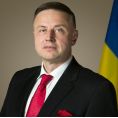
H E Andrii Kuzmenko
Four years ago, on 24 February 2022, Russia launched its full-scale invasion of Ukraine — an act that shook not only European security but the foundations of the international order.
For some, it was another geopolitical crisis. For Ukrainians, it became daily life.
And for many across the Middle East and Africa — in societies that have endured war themselves — the images from Ukrainian cities require little explanation: damaged hospitals, disrupted electricity, families sheltering from strikes, children growing up under the sound of drones. The geography is different. The experience is not.
— A war against infrastructure and endurance
Unable to achieve decisive victory on the battlefield, Russia has intensified attacks on Ukraine’s civilian infrastructure. The winter of 2025–2026 became one of the harshest chapters of this war.
Thermal power plants, substations, transformers — systematically targeted.
As President Volodymyr Zelenskyy noted at the Munich Security Conference this year, in a single large-scale attack Russia deployed nearly 250 drones and missiles. In January alone, more than 6,000 attack drones, over 150 missiles of various types, and thousands of aerial bombs were launched against Ukraine. There is no major power station left undamaged.
The objective is not purely military. It is to make daily life unsustainable.
— To exhaust society
This strategy is painfully familiar in many parts of the world. When electricity collapses, hospitals struggle. When water systems are damaged, communities suffer. When grain storage is destroyed, prices rise far beyond the immediate battlefield.
Civilian life itself has become a battlefield.
— Resilience beyond the front line
Yet Ukraine continues to function. Energy workers repair substations often within hours of strikes. Digital infrastructure allows public services to operate even during blackouts. Schools reopen. Businesses adapt.
Despite disparities in military scale and resources, Ukraine’s Armed Forces continue to defend hundreds of kilometres of frontline. Ukrainian engineers and technology specialists have developed domestic drone systems and digital command tools, turning limited resources into strategic advantage.
This resilience is not rhetorical. It is practical, daily work — sustained by society’s unity and the support of international partners.
—Why this war matters beyond Europe
Ukraine was among the world’s largest exporters of wheat, corn and sunflower oil before 2022. When Russian forces blockaded Ukrainian ports and targeted grain infrastructure, the impact was not confined to Europe.
Markets across Africa and the Middle East felt the pressure. Food prices rose in regions already facing fragility. Supply chains tightened.
When grain silos burn in Odesa, bread becomes more expensive thousands of kilometres away. Global markets are interconnected. So is insecurity.
If large-scale invasions and systematic attacks on civilian infrastructure become normalised, instability does not remain local. It travels. Impunity spreads.
For regions that prioritise stability, economic diversification and long-term planning, predictability in global affairs is not abstract, it is essential.
— Qatar’s responsible engagement
In this context, the role of responsible diplomatic actors becomes crucial.
The State of Qatar has demonstrated constructive engagement throughout this war, through humanitarian assistance and sensitive mediation efforts on complex humanitarian matters, including issues related to Ukrainian children and other civilian concerns.
Ukraine deeply values this role. Qatar’s diplomatic philosophy — grounded in dialogue, mediation and humanitarian responsibility — contributes to mitigating fragmentation in a polarised international environment. In times when conflict narratives harden positions, such engagement helps preserve space for humanity.
Our cooperation reflects shared interests in stability and in a peace rooted in international law rather than force.
— A strategic investment in stability
Ukraine urgently requires continued support — including air defence systems, energy equipment, generators, transformers and materials necessary to restore critical infrastructure.
Such assistance is humanitarian. But it is also strategic.
A resilient Ukraine strengthens broader European and global stability. Protecting civilian infrastructure protects economic continuity. Defending sovereignty reinforces a principle that safeguards states of all sizes.
If Ukraine were to fall, the consequences would extend beyond Europe — destabilising the Black Sea region, disrupting food and energy routes, and weakening confidence in the idea that borders are protected by law.
The stakes are global.
— Looking ahead
Four years into this war, Ukraine remains standing — not because the suffering has been small, but because surrender would mean accepting that civilian life can be deliberately weaponised.
Peace will come. But for the sake of humanity, it must reaffirm a simple truth: civilian infrastructure is not a legitimate target, and territory cannot be taken by force.
For societies that understand the cost of instability, this principle is not distant. It is personal.