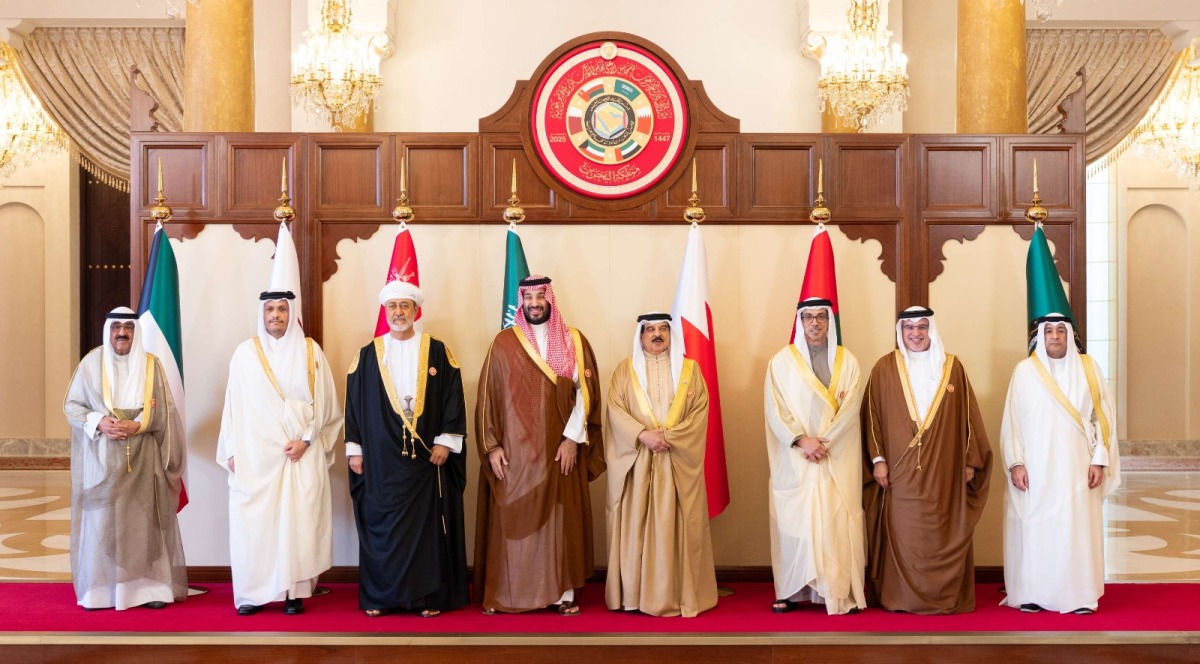
Manama: The Supreme Council of the Gulf Cooperation Council (GCC) commended the pivotal role played by the State of Qatar with regional and international parties and guarantor states, and its efforts to achieve a ceasefire in Gaza and secure the release of hostages and detainees.
The Council also praised Qatar's contribution to completing negotiations and solidifying the agreement, thus paving the way for a just and comprehensive peace process that enhances regional stability.
This came in the final statement issued at the conclusion of the 46th session of the Supreme Council of the GCC, held on Wednesday in the Bahraini capital, Manama, with the participation of the State of Qatar and under the chairmanship of Bahrain.
The statement was issued at the conclusion of the summit.
In its concluding statement, the Supreme Council commended the efforts of US President Donald Trump and the outcomes of the Sharm El Sheikh Peace Summit, held in the Arab Republic of Egypt on Oct. 14, 2015.
It also praised the agreement reached regarding Gaza, signed by the State of Qatar, the Arab Republic of Egypt, the Republic of Turkiye, and the United States, and the commencement of the first phase aimed at ending the war on the Gaza Strip and paving the way for a comprehensive and just peace.
The Council further commended the active role of the guarantor states in reaching this agreement and stressed the necessity for all parties to adhere to the ceasefire agreement.
The final statement of the 46th Gulf Cooperation Council (GCC) Summit commended Qatar's diplomatic efforts in reaching the Doha Framework Agreement for Peace between the government of the Democratic Republic of Congo and the Congo River Alliance (M23 Movement), signed in Doha on Nov. 15.
The statement affirmed the commitment of both parties to addressing the root causes of the conflict through structured dialogue, confidence-building measures, respect for human rights, ensuring the safe and dignified return of displaced persons, and supporting national reconciliation and unity.
This is all within the framework of the peace process facilitated by the State of Qatar, based on the Doha Declaration of Principles signed on July 19, 2025.
The Supreme Council welcomed the unanimous adoption by the Human Rights Council, on Oct. 7, 2025, of the resolution submitted by the State of Qatar on Promoting and Protecting the Human Rights of Women and Children in Conflict and Post-Conflict Situations.
It also commended the State of Qatar's successful hosting of the Second World Summit for Social Development, held in Doha in November 2025.
Furthermore, the Council welcomed the Doha Political Declaration issued by the Summit, which affirmed the completion of a new phase in the global effort to consolidate social justice and place human beings at the heart of development.
The final statement of the 46th Summit reiterated its praise for the State of Qatar's efforts and its announcement of the opening of the natural gas pipeline between Turkiye and Syria, noting the efforts of all GCC member states to support Syria's recovery and stability.
The Supreme Council welcomed the agreement on an immediate ceasefire between Pakistan and Afghanistan and the establishment of mechanisms to consolidate lasting peace and stability between the two countries, commending in this regard the diplomatic efforts and constructive role played by both the State of Qatar and the Republic of Turkiye.
The Supreme Council, in its final statement issued at the Manama Summit, also praised the State of Qatar's successful mediation in reuniting Ukrainian and Russian children with their families, noting the efforts of all GCC member states and their success in mediating the exchange of prisoners between the two sides, stemming from their commitment to humanitarian principles and international solidarity in building peace and stability.
The Supreme Council of the Cooperation Council for the Arab States of the Gulf (GCC) congratulated the State of Qatar on the success of the FIFA U-17 World Cup, which Doha hosted in November 2025.
The Supreme Council also expressed its best wishes to Qatar for success in the 11th edition of the Arab Cup, organized by FIFA.
Furthermore, the Supreme Council expressed its support for Qatar's bid to host the 2036 Olympic and Paralympic Games, wishing the country every success in hosting this global sporting event.
The Supreme Council of the Gulf Cooperation Council (GCC) stressed that the security of the GCC states is indivisible, and that any attack on any one of them is an attack on all, in accordance with the GCC Charter and the Joint Defense Agreement.
This reaffirms the statements issued in the statement of its extraordinary session and the statement of the emergency Arab-Islamic Summit held in Doha on Sep. 15, 2025.
This came in the final statement issued at the conclusion of the 46th session of the Supreme Council of the GCC, held today in the Bahraini capital, Manama, with the participation of the State of Qatar and under the chairmanship of Bahrain.
In the final statement, the Supreme Council affirmed its commitment to the strength and cohesion of the GCC, the unity of its members, and achieving greater coordination, integration, and cooperation in all fields, to fulfill the aspirations of the citizens of the GCC states.
It also emphasized that its member states stand united in the face of any threat to any of them.
The Council approved the gradual implementation of the customs data exchange platform during the second half of 2026.
It tasked the relevant ministerial committees with finalizing the remaining requirements for the Customs Union and submitting an executive action plan and timetable as soon as possible.
Within the framework of the Gulf Common Market, the Supreme Council emphasized the need to establish mechanisms for monitoring the implementation of regulations governing cross-border trade in services among GCC countries, periodically measuring their economic and social impact, and defining mechanisms for the mutual recognition of professional qualifications and service licenses among member states.
The final statement expressed the Supreme Council's support for the proposal to hold the "Made in the Gulf" Forum and Exhibition in October 2026, to showcase the distinguished industrial capabilities of the GCC countries and enhance industrial integration.
The Council also approved the establishment of the GCC Civil Aviation Authority, headquartered in the United Arab Emirates (UAE), and the General Agreement for Linking the GCC States to the Railway Project.
Furthermore, the Supreme Council approved the unified rules for owners of jointly owned properties in the GCC countries.
The Supreme Council commended the achievements and efforts of member states in the field of Islamic affairs and endowments, promoting and disseminating a correct understanding of Islam and showcasing its true image, and adopted the Gulf Week for Strengthening Religious and Moral Values for the Family.
The Council emphasized the importance of supporting the stability of global energy markets, adopting a balanced approach that does not exclude any energy sources, and working to develop technologies that enable the management of emissions and the efficient utilization of all energy sources to enable sustainable economic growth for all.
It also commended the achievements and efforts of member states in the circular carbon economy approach and encouraged cooperation among GCC countries to implement this approach in relevant policies, mechanisms, strategies, plans, and initiatives.
The GCC leaders have reiterated their commitment to preserving the stability and security of the Gulf region, safeguarding the prosperity of its peoples and strengthening the GCC's role in promoting peace and sustainable development. Leaders stressed adherence to the principles of sovereignty and non-interference, rejecting any threats to member states and affirming that the security of the six nations is indivisible.
The council delivered some of its most forceful language on the war in Gaza, expressing full support for the Palestinian people and calling for an end to the blockade on the territory. It demanded the opening of all crossings to allow sustained flow of humanitarian aid, protection for civilians, and full compliance with international law.
Gulf leaders warned against any attempts to forcibly displace residents of Gaza and reiterated support for the establishment of an independent Palestinian state on the 1967 borders with East Jerusalem as its capital. Israel, they said, bears full responsibility for the ongoing violations in Gaza, which they noted have resulted in tens of thousands of civilian deaths, mostly women and children.
The communique also condemned Israeli actions in the West Bank and called for intensified international efforts to resolve the conflict.
On Iran, the GCC stressed the need for constructive cooperation between Tehran and the International Atomic Energy Agency, while condemning Israeli strikes on Iranian nuclear facilities, warning these posed a threat to regional and global security.
The statement reaffirmed the UAE's sovereignty over the three disputed islands (Greater Tunb, Lesser Tunb and Abu Musa) currently controlled by Iran.
On Iraq, the council voiced support for efforts to safeguard the country's stability, unity, and Arab identity. It also backed Yemen's Presidential Leadership Council and praised the UN-led push for a comprehensive political settlement, urging continued commitment to the truce.
Regarding Syria, the leaders reiterated support for the country's sovereignty and condemned repeated Israeli attacks inside Syrian territory. They called on Syrian parties to pursue dialogue and reject division.
In Lebanon, the GCC emphasized support for the fragile ceasefire reached in November 2024 and condemned continued Israeli strikes that have caused mass displacement and damage to civilian infrastructure. It also voiced concern over attacks targeting UN peacekeepers.
The communique backed efforts to achieve peace in Sudan, calling for civilian protection, unhindered humanitarian access and progress toward a civilian-led government.
On Libya, the council renewed support for a Libyan-led political process, the withdrawal of foreign forces, and UN efforts to pave the way for elections and institutional unity.
The GCC also reiterated its support for Somalia's stability and called on the international community to bolster assistance to the country.
Gulf leaders restated their longstanding support for Morocco's sovereignty over Western Sahara and welcomed the UN Security Council's recent endorsement of Morocco's autonomy plan as a realistic basis for resolving the dispute.
The council highlighted the importance of protecting regional waterways, warning against attacks on commercial shipping and energy infrastructure. It urged all parties to pursue de-escalation and diplomacy to avert further instability.