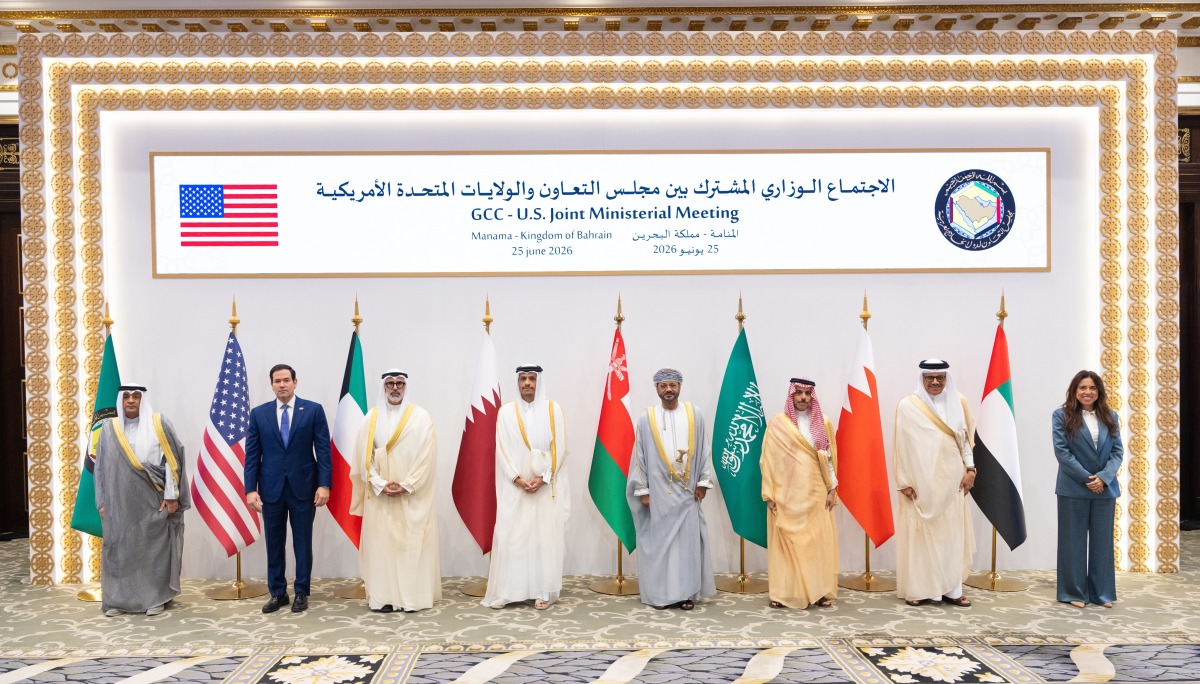
Manama, Bahrain: Prime Minister and Minister of Foreign Affairs H E Sheikh Mohammed bin Abdulrahman bin Jassim Al-Thani yesterday participated in Manama in the joint ministerial meeting of Their Highnesses and Excellencies GCC foreign ministers, with the participation of Secretary of State of the United States of America H E Marco Rubio.
The meeting addressed a number of regional developments and their implications for the security of GCC states and the region, particularly diplomatic efforts aimed at enhancing security and stability following the signing of the memorandum of understanding between the United States and the Islamic Republic of Iran.
The meeting stressed that any future understandings or arrangements must include the requirements of GCC states in a manner that safeguards their interests and ensures their security and stability, and should be based on the principles of international law, respect for state sovereignty, good neighborliness, and non-interference in internal affairs, contributing to regional security and stability.
The meeting welcomed all diplomatic efforts that contribute to de-escalation, enhance security and stability in the region, and ensure the security of maritime routes, including the Strait of Hormuz, freedom of navigation, and respect for international law, in a way that promotes security and prosperity for the peoples of the region and the world.
Meanwhile, Foreign ministers from the United States and GCC states have reaffirmed their strategic partnership and welcomed mediation efforts by Qatar and Pakistan that contributed to a memorandum of understanding between Washington and Tehran.
In a joint statement, ministers praised the signing of the US-Iran agreement on June 17 and called for sustained momentum in negotiations aimed at securing a lasting end to hostilities.
The ministers reiterated their shared objective of preventing Iran from acquiring a nuclear weapon and stressed that lasting regional peace requires addressing broader security concerns, including Iran’s ballistic missile program, drone capabilities and support for regional proxies.
They also underlined the importance of keeping the Strait of Hormuz open to international shipping, rejecting any attempts to impose restrictions, fees or control over the strategic waterway. The statement further noted that future trade and investment with Iran would depend on its compliance with the agreement and its commitment to reducing destabilizing activities in the region.
The ministers pledged continued support for Syria’s government and people, backing efforts to combat terrorism, restore essential services, improve investment conditions and facilitate the voluntary return of refugees and internally displaced people. They also reiterated their commitment to Syria’s sovereignty, unity and territorial integrity.
The ministers likewise expressed support for Lebanon’s sovereignty and welcomed US-sponsored talks between Israel and Lebanon aimed at securing a lasting peace and resolving border issues. They stressed the importance of maintaining the negotiation process and called for all non-state armed groups in Lebanon to be disarmed, while strengthening the role of the Lebanese Armed Forces.
On Gaza, the ministers reaffirmed support for a US-backed plan to end the conflict and advance reconstruction efforts. They called for the disarmament of non-state armed groups and the transfer of administrative responsibility to an independent Palestinian technocratic committee. The statement also reiterated support for Palestinian self-determination and the eventual establishment of a Palestinian state.
The ministers condemned attacks by Iran-aligned groups in Iraq against GCC states and voiced support for efforts by Iraq’s government to bring all weapons under state control.